Get Full Government Meeting Transcripts, Videos, & Alerts Forever!
Get email alerts on the Offsets Carbon Capture topic
No spam. Unsubscribe anytime.
Offsets, carbon removal and nature‑based projects draw scrutiny and support in reauthorization debate
Summary
CARB and outside witnesses debated the role of offsets, carbon capture and nature‑based solutions in achieving mid‑century carbon neutrality while addressing concerns about additionality, buffer pools, and environmental justice benefits to tribal nations and frontline communities.
At the Joint Legislative Committee hearing CARB officials and outside witnesses discussed the role offsets, carbon capture and nature‑based solutions must play to meet California’s long‑term greenhouse‑gas goals.
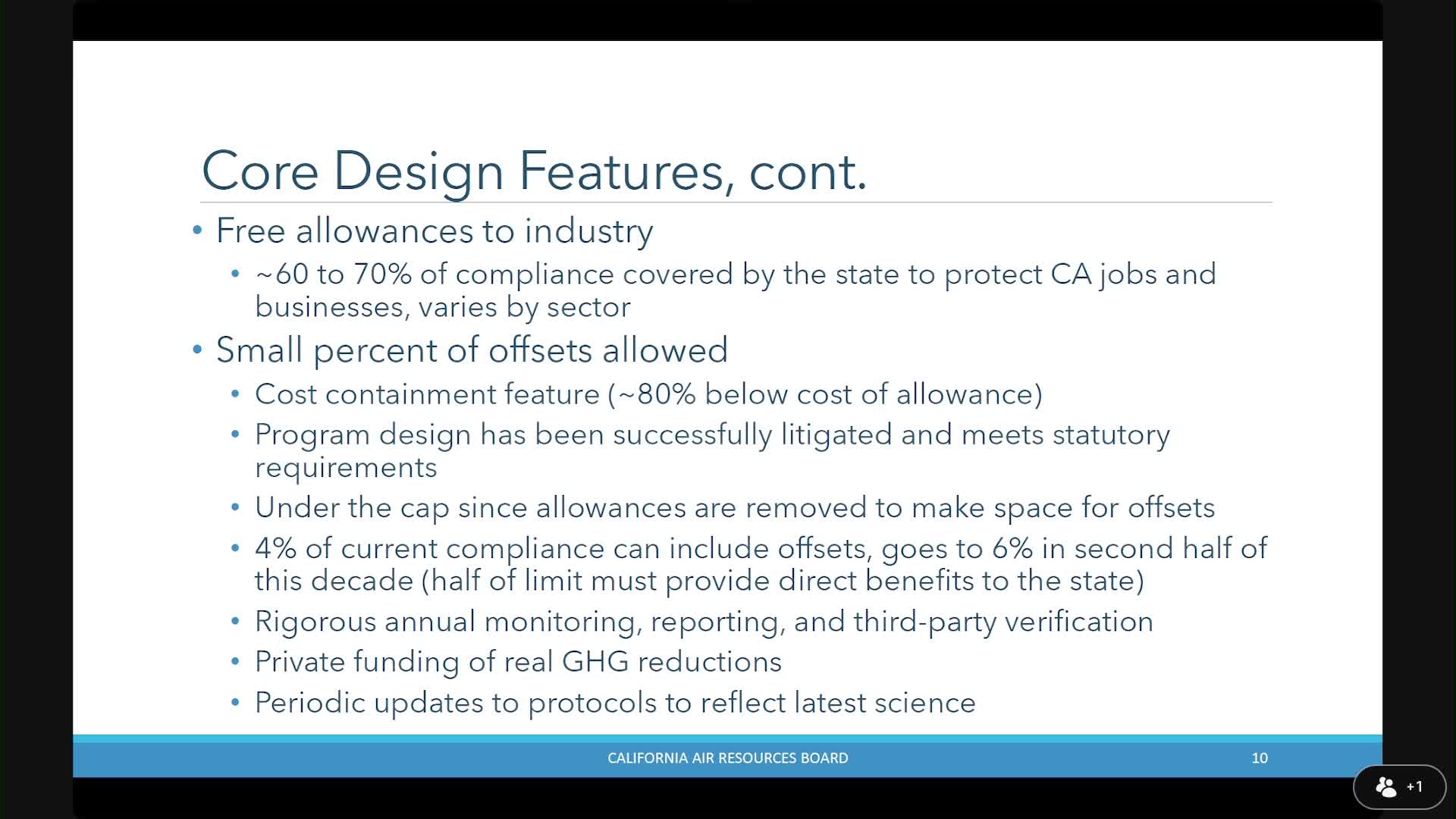
CARB staff explained that offsets were intentionally limited when the program was designed — allowances were removed up front to make room for offsets under the cap — and that offsets are currently limited to 4% of compliance (rising to 6% in 2025). Steven Cliff told lawmakers that offsets are subject to annual monitoring, third‑party verification and protocol updates; he cited forestry protocol revisions and noted a forestry buffer pool of about 27 million offsets that has been used fewer than 10 times.
Panelists and public speakers described competing assessments of offsets. Supporters — including offset developers and representatives of tribal projects — emphasized that offsets provide private investment for reductions in sectors not covered directly by the cap and have generated revenue for tribal nations. CARB staff estimated that certain offset projects administered by tribal nations generated roughly $1.5 billion in revenue for those tribal governments.
Critics in the hearing raised questions about additionality, whether some projects would have occurred without offset funding, and whether offsets reduce incentives for direct emission reductions at covered facilities. Independent and academic witnesses noted that removing offsets from the program would raise compliance costs and eliminate a funding stream for particular projects; others urged tighter protocols and greater transparency to build public trust.
Separately, lawmakers and experts discussed carbon capture and removal technologies as a necessary component of deep decarbonization. CARB staff said the scoping plan projects a role for carbon capture and direct air capture to meet mid‑century targets, and panelists urged policies to help scale those technologies while ensuring rigorous monitoring and durable storage.
Ending: The committee heard calls both to preserve offsets with stronger safeguards and to consider complementary investments in nature‑based solutions; stakeholders asked CARB and the Legislature to clarify standards, monitoring and community benefits if offsets remain part of a redesigned program.