Get Full Government Meeting Transcripts, Videos, & Alerts Forever!
Get email alerts on the Affordability topic
No spam. Unsubscribe anytime.
Lawmakers, analysts and experts debate how to use cap‑and‑trade revenues to ease costs for Californians
Summary
Analysts, CARB staff and academics told legislators that cap‑and‑trade revenues and the California Climate Credit can be restructured to address household affordability, especially for low‑income and hot‑climate households, and floated options including more visible credits, targeted rebates and using GGRF to lower infrastructure costs.
Lawmakers and policy analysts at the Joint Legislative Committee on Climate Change Policies spent the hearing probing how California’s cap‑and‑trade program affects families’ household budgets and how auction proceeds might be used to ease those pressures.
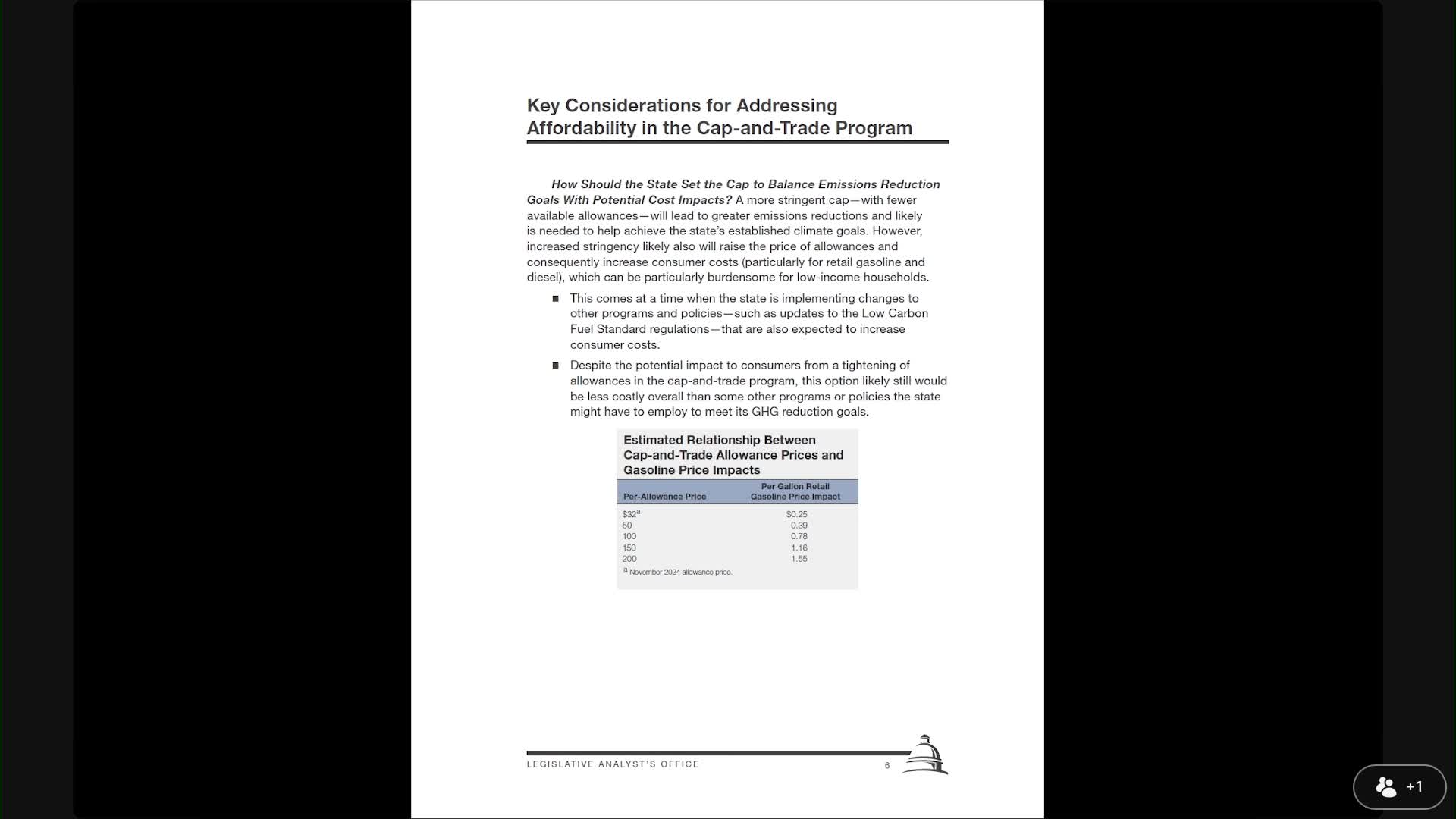
Helen Kerstien of the Legislative Analyst's Office told the committee that electricity and natural gas price impacts are likely modest because utilities receive allocations that have been returned as bill credits. By contrast, she said, gasoline and diesel are more carbon‑intensive and costs there tend to be passed through at the pump; LAO estimated the program’s contribution to retail gasoline in California is roughly 25¢ per gallon.
Independent Emissions Market Advisory Committee Chair Meredith Fowlie, and Stanford scholar Michael Wara, told the committee carbon pricing is an efficient way to signal low‑cost abatement across many sectors, but conceded that the program’s political sustainability depends on visible benefits for households. Wara proposed repurposing or more sharply targeting the California Climate Credit so it reaches low‑income households and high‑heat communities during peak months, and proposed using some GGRF revenue to “buy down” the cost of electric grid upgrades and transmission projects so ratepayers face smaller rate increases.
Experts and CARB staff discussed several concrete options lawmakers may consider: lowering a price ceiling, changing allowance allocations (for example, more directly allocated allowances to utilities tied to visible customer benefits), directing GGRF revenues into direct rebates or targeted affordability programs, or funding a portion of electrification and transmission infrastructure directly from auction proceeds to reduce ratepayer financing costs.
CARB Executive Officer Steven Cliff and staff said the state currently returns funds to ratepayers through the California Climate Credit (CARB cited about $13 billion provided historically for residential utility consumer protection), but officials acknowledged the credit is not widely understood. Several witnesses recommended delivering benefits when consumers face the largest monthly bills (for example, in hot summer months for Central Valley households) or through direct payments rather than a biannual bill line‑item.
Ending: Committee members urged CARB and the administration to accelerate technical work and public workshops so the legislature can consider statutory direction this year. Lawmakers said they want detailed modeling of consumer impacts for the allowance‑removal options CARB is evaluating.