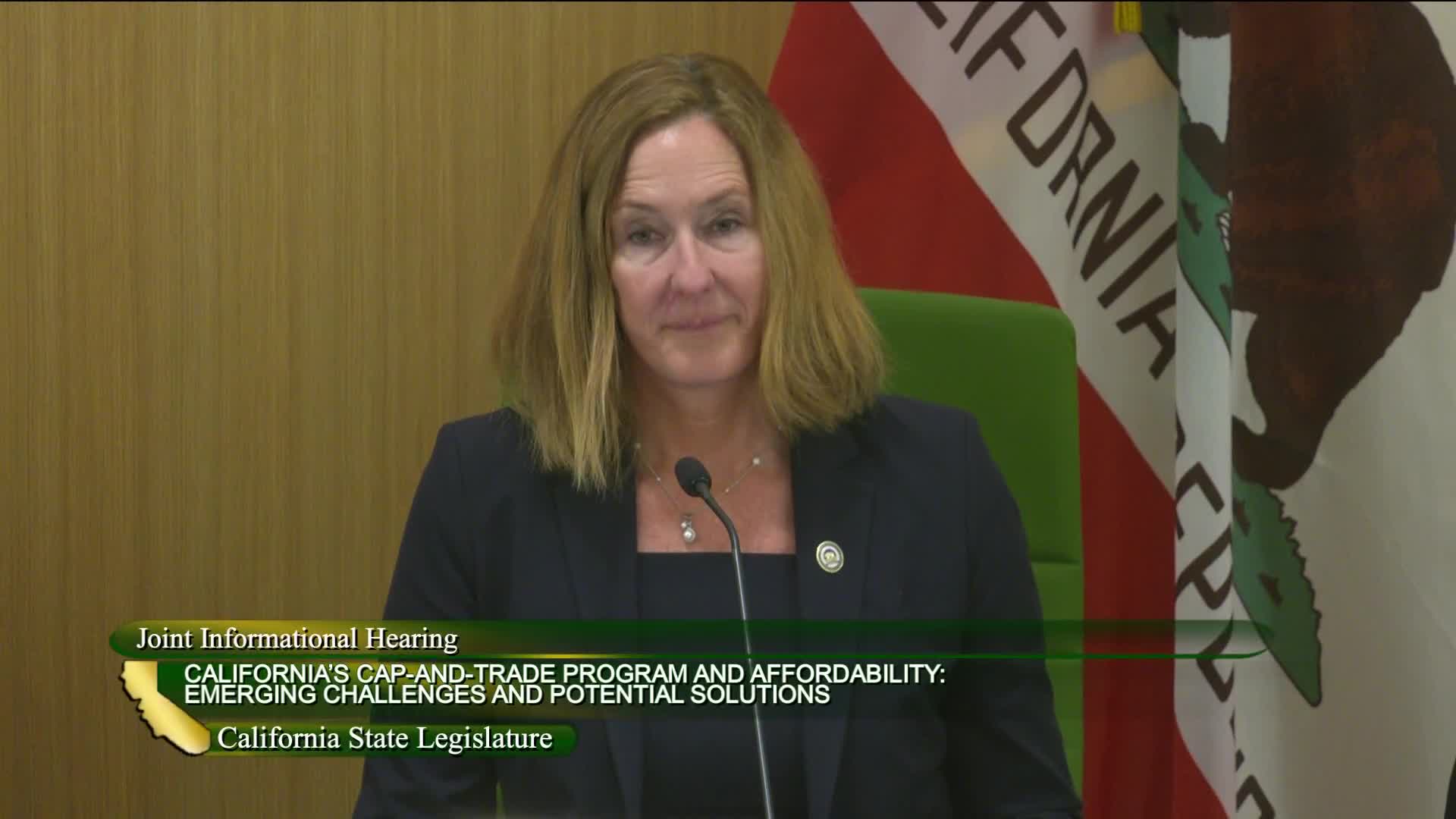
CARB lays out cap-and-trade design, warns uncertainty has cut auction revenues
Loading...
Summary
California Air Resources Board leaders told a joint legislative committee that cap-and-trade remains a cost‑effective core of the state's climate strategy, but regulatory and federal uncertainty has depressed auction revenues and poses challenges for reauthorization through 2045.
Leaders from the California Air Resources Board told the Joint Legislative Committee on Climate Change Policies on Thursday that the cap‑and‑trade program remains a central, cost‑effective tool for meeting state greenhouse‑gas targets but that uncertainty about the program’s future has reduced auction revenues and could complicate reauthorization.
CARB Chair Liane Randolph said the agency is committed to defending California climate programs and described cap‑and‑trade as part of a “portfolio approach” that pairs pricing with prescriptive regulations and incentives. Executive Officer Steven Cliff said the program has produced measurable public‑benefit funding, supported lower fuel costs through efficiency gains and created market signals that accelerate clean technology deployment.
CARB senior staff told lawmakers the program covers roughly 80% of the state’s greenhouse‑gas emissions, has run 50 quarterly auctions, and has generated more than $31 billion deposited to the Greenhouse Gas Reduction Fund (GGRF). Cliff added that auction proceeds have funded the California Climate Credit — a residential bill credit tied to utility allowance returns — and that 70% of appropriated GGRF dollars have been directed to benefit disadvantaged communities.
CARB described the program’s core design features: an annually declining statewide cap (about a 4% annual reduction tied to the 2030 target), multi‑year compliance periods, banking of allowances, trading, limited use of offsets, a cost‑containment reserve, and a combination of free allocations and auctioned allowances. Cliff said about 15% of allowances historically were allocated directly to protect industry competitiveness, 38% were returned to utilities (including the climate credit), and 42% were sold at auction.
On offsets, CARB staff said they were intentionally limited at program start to leave space under the cap; offsets are currently capped at 4% of compliance and rise to 6% starting in 2025, with half of offsets required to provide direct environmental benefits to California. Cliff said the program's forestry buffer pool currently holds roughly 27 million offsets and has been drawn on fewer than 10 times.
CARB officials warned lawmakers that recent auctions have brought in unusually low revenues — the latest auction returned about $850 million — and attributed part of the decline to policy uncertainty. Cliff urged policy certainty for private investment in clean technologies, noting periods of lower auction revenue coincided with prolonged regulatory debate.
Lawmakers pressed CARB about options for aligning the cap with statutory targets adopted after the 2022 scoping plan. Cliff said staff are evaluating options that range from a technical inventory alignment (roughly 110 million fewer allowances) to larger reductions (up to about 265 million) to reach a 48% reduction target by 2030; he said the largest option would be most costly but that CARB has posted analyses for the public.
Ending: CARB pledged continued engagement with the legislature and stakeholders as staff complete rulemaking materials and technical analyses related to reauthorization. The agency emphasized that while California cannot unilaterally solve global emissions, maintaining domestic policy durability is essential for continued investment and innovation.