Get Full Government Meeting Transcripts, Videos, & Alerts Forever!
Minn. Senate committee holds informational hearing on proposed Brady/Giglio disclosure reforms
Summary
The Minnesota Senate Judiciary and Public Safety Committee held an informational hearing on Feb. 26, 2025, on competing proposals to clarify how prosecutors and law enforcement handle Brady/Giglio material and whether officers may contest designations that could affect their employment.
The Minnesota Senate Judiciary and Public Safety Committee held an informational hearing on Feb. 26, 2025, on competing proposals to clarify how prosecutors and law enforcement handle Brady/Giglio material and whether officers may contest designations that could affect their employment.
The committee heard from authors and stakeholders behind Senate File 599 (Sen. Seaburger) and Senate File 1813 (Sen. Westlund), testimony from prosecutors, chiefs of police and sheriffs, labor attorneys and the state public defender, and presentations on how existing practices vary across Minnesota’s 87 counties.
Why it matters: Brady and Giglio obligations require prosecutors to disclose evidence that is exculpatory or could be used to impeach a witness’s credibility. Witness credibility issues that become known to prosecutors can affect the course of criminal prosecutions and, stakeholders said, can also have career consequences for officers whose records are treated as Brady/Giglio material.
Labor attorneys representing officers told the committee a uniform process is necessary to protect officers’ due process rights and to avoid employment actions taken solely because a prosecutor has labeled an officer Brady-impaired. Kevin Beck, a labor attorney in St. Paul, described an arbitration he handled in which a newly elected county attorney designated an officer Brady-impaired based on incidents many years earlier; Beck said the officer “had no recourse” to challenge that designation and that the employer subsequently fired the officer. Beck called the bills “a due process issue for public employees.”
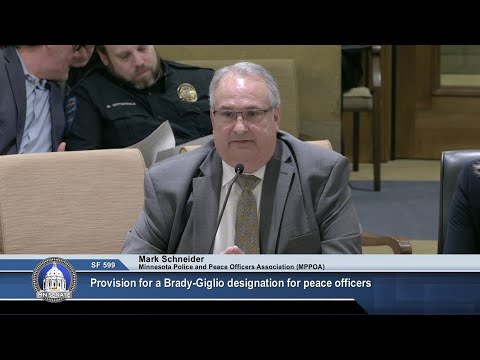
Mark Schneider, general counsel at Law Enforcement Labor Services, said the proposals seek to create a “uniform procedure” allowing notice, reconsideration and judicial review when a prosecutor designates an officer Brady-impaired. “One of the most important aspects of our bill is the fact that a Brady designation cannot…
Already have an account? Log in
Subscribe to keep reading
Unlock the rest of this article — and every article on Citizen Portal.
- Unlimited articles
- AI-powered breakdowns of topics, speakers, decisions, and budgets
- Instant alerts when your location has a new meeting
- Follow topics and more locations
- 1,000 AI Insights / month, plus AI Chat