Get Full Government Meeting Transcripts, Videos, & Alerts Forever!
Get email alerts on the Brady Giglio Disclosure Reform topic
No spam. Unsubscribe anytime.
Minn. Senate committee holds informational hearing on proposed Brady/Giglio disclosure reforms
Summary
The Minnesota Senate Judiciary and Public Safety Committee held an informational hearing on Feb. 26, 2025, on competing proposals to clarify how prosecutors and law enforcement handle Brady/Giglio material and whether officers may contest designations that could affect their employment.
The Minnesota Senate Judiciary and Public Safety Committee held an informational hearing on Feb. 26, 2025, on competing proposals to clarify how prosecutors and law enforcement handle Brady/Giglio material and whether officers may contest designations that could affect their employment.
The committee heard from authors and stakeholders behind Senate File 599 (Sen. Seaburger) and Senate File 1813 (Sen. Westlund), testimony from prosecutors, chiefs of police and sheriffs, labor attorneys and the state public defender, and presentations on how existing practices vary across Minnesota’s 87 counties.
Why it matters: Brady and Giglio obligations require prosecutors to disclose evidence that is exculpatory or could be used to impeach a witness’s credibility. Witness credibility issues that become known to prosecutors can affect the course of criminal prosecutions and, stakeholders said, can also have career consequences for officers whose records are treated as Brady/Giglio material.
Labor attorneys representing officers told the committee a uniform process is necessary to protect officers’ due process rights and to avoid employment actions taken solely because a prosecutor has labeled an officer Brady-impaired. Kevin Beck, a labor attorney in St. Paul, described an arbitration he handled in which a newly elected county attorney designated an officer Brady-impaired based on incidents many years earlier; Beck said the officer “had no recourse” to challenge that designation and that the employer subsequently fired the officer. Beck called the bills “a due process issue for public employees.”
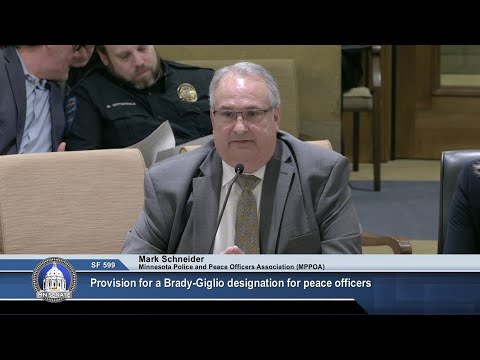
Mark Schneider, general counsel at Law Enforcement Labor Services, said the proposals seek to create a “uniform procedure” allowing notice, reconsideration and judicial review when a prosecutor designates an officer Brady-impaired. “One of the most important aspects of our bill is the fact that a Brady designation cannot and should not be the sole basis for termination,” Schneider testified.
Law enforcement leaders — including Maple Grove Police Chief Eric Warner, who said he represents Minnesota chiefs in national groups — and the Minnesota Sheriffs Association urged a statutory framework that sets statewide expectations, notifications and coordination between prosecutors and chiefs. Warner told the committee the designation currently “rests solely on a prosecutor and can have career-ending consequences for an officer.” Sheriff Brian Welk of Cass County told the committee sheriffs “recognize that disciplinary decisions should not be based solely on existence of Brady Giglio designation” and asked that agencies be allowed to review and investigate underlying conduct.
County attorneys and prosecutors pushed back on proposals that would create new statutory restrictions on prosecutorial practices or that might hamper prosecutors’ ability to obtain nonpublic law-enforcement records needed to meet constitutional disclosure obligations. Brad Johnson, Anoka County Attorney, and Kevin Magnuson, Washington County Attorney, said the Minnesota County Attorneys Association (MCAA) is working on recommended statewide policies and best practices and cautioned against rushing statutory mandates without prosecutor input. Johnson said some bill provisions raise separation-of-powers and constitutional concerns, and Magnuson said federal law does not require a centralized “Brady list” and cautioned that policies should focus on data and process rather than branding individuals.
Hennepin County Attorney’s Office Director of Professional Standards Claire Deagle told the committee that prosecutorial access to relevant nonpublic records is the practical choke point. Deagle said Hennepin’s office has a three-person Brady team and that in the past six months the office filed “393 motions” under Minnesota law to obtain records for in-camera review; she said Hennepin has 38 law enforcement agencies within the county and that the current process—where judges are asked to order production and courts then review data—creates litigation and delays. Deagle said the Hennepin office supports legislation amending the Minnesota Government Data Practices Act to permit timely sharing of otherwise nonpublic personnel or internal-investigation records with prosecutors under appropriate safeguards.
Representatives of the defense bar urged caution about statutory changes that would slow disclosure to defendants. Bill Ward, Minnesota State Public Defender, said the bills “infringe our ability to also represent our clients” and urged that proposals not delay prosecutors’ existing obligations; Ward referenced a recent U.S. Supreme Court decision he cited by name as an example of the high stakes when prosecutors fail to correct false testimony.
Key differences in the measures: Senator Seaburger described a House Delete-All amendment tied to Senate File 599 that resulted from stakeholder negotiation between police chiefs and unions; that amendment would (among other provisions) narrow what internal-investigation outcomes qualify as Brady material and include language barring termination solely for Brady designation while preserving authority for discipline based on underlying conduct. Senator Westlund’s Senate File 1813 also directs a process for prosecutors to collect potential Brady/Giglio data, provides a reconsideration mechanism for officers, and requires prosecutorial notice to law enforcement when a court has made credibility findings. Committee members noted definitional differences between the bills—especially around whether “bias,” “abuse of authority,” or broader credibility categories are part of the statutory definition—and asked sponsors to continue negotiating a common definition.
Committee members and witnesses emphasized several practical constraints. County attorneys and assistant prosecutors described large caseloads, decentralized recordkeeping and differences among municipal, county and state agencies in how records are classified and shared under the Minnesota Government Data Practices Act (chapter 13). Assistant St. Louis County Attorney Jonathan Holets gave examples of where low-level supervisory coaching or background-check questionnaires, although not discipline, can nonetheless contain information prosecutors may need to evaluate for disclosure. Magnuson and others said good communication and memoranda of understanding between prosecutors and law enforcement can reduce conflicts but that some counties still use subpoenas and court orders to resolve access questions.
Next steps and outstanding issues: Testimony repeatedly urged stakeholder negotiations to resolve definition, access, and process disagreements before the Legislature adopts a statutory scheme. County attorneys urged continued leadership by prosecutors in drafting workable policy; chiefs and sheriffs urged a statute to guarantee timely notice, a reconsideration pathway for officers and an assurance that designation alone will not dictate employment outcomes; labor representatives sought clear protections for officers’ employment rights and judicial review; and defense counsel warned against measures that would delay disclosure to defendants.
Committee Chair Latson said she intends to continue the conversation and try to take action this year, noting the complexity of balancing constitutional disclosure duties, officer due process and the logistics of nonpublic data access across 87 counties.
Ending note: The hearing did not include formal votes; senators and stakeholders repeatedly invited further negotiation among county attorneys, law enforcement leadership, labor unions and defense counsel to produce a narrower, agreed framework before any statutory requirement is enacted.