Get Full Government Meeting Transcripts, Videos, & Alerts Forever!
Get email alerts on the Avian Influenza Poultry topic
No spam. Unsubscribe anytime.
Turkey farmers describe losses from HPAI and urge grants for prevention; committee lays bill over
Summary
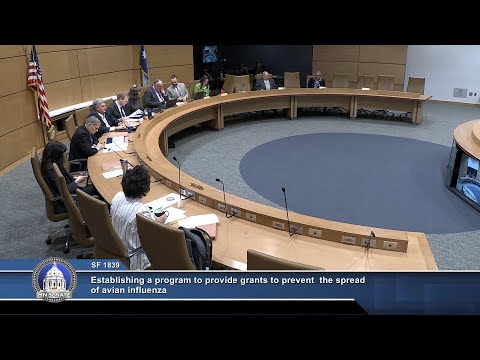
Turkey growers and farm board officials described high losses from highly pathogenic avian influenza and a more recent respiratory virus, urging continued funding for response and a new grant program to support preventive measures such as laser deterrents. Senate File 1839 was laid over for possible inclusion.
Turkey growers and public-health officials told the Senate agriculture committee Feb. 26 that highly pathogenic avian influenza (HPAI) and a newly arrived respiratory virus have caused major flock losses and financial strain, and they urged lawmakers to fund prevention grants proposed in Senate File 1839.
The committee heard firsthand accounts and industry data that framed the bill which would appropriate resources to a program to provide grants to prevent the spread of avian influenzaas a response to ongoing disease pressure.
Why it matters: Testimony emphasized both the scale of recent commercial losses and the human toll on family farms. Witnesses said both federal indemnity and state response capacity matter, but biosecurity measures and supplemental technologies can reduce future losses.
Ashley Coles, executive director of the Minnesota Turkey Growers Association, told the committee Minnesota leads the nation in turkey production, raising about 40 million turkeys annually on roughly 600 farms. Coles said the industry contributes about $16 billion to the state economy and supports more than 51,000 jobs, and she called continued funding for the Board of Animal Health and MDA a priority.
Erica Swatzky, a sixth-generation turkey farmer from Kensington and president of the board of the Board of Animal Health, gave a first-person account of a HPAI outbreak on her farm in which she said mortality climbed rapidly, her flock was depopulated the next day after test results, and her family spent about 10 weeks in response and cleaning. "A silent barn is not only sad, but it's truly very eerie," Swatzky said. She described building compost piles and working with subject-matter experts from the board and federal partners during the response.
Coles also described the arrival in 2024 of avian metapneumovirus (AVMPV), a highly contagious respiratory virus that presents similarly to HPAI but is not a foreign animal disease; industry-funded sampling in April 2024 reportedly found the virus in 100% of the state's sampled flocks within 90 days.
The committee also heard technical details on response and disposal. Witnesses described how composting infected birds is handled under Board of Animal Health protocols, including subject-matter expert guidance, daily temperature monitoring and a multi-week holding period to inactivate the virus. Dr. Bridal Hayes, executive director for the Board of Animal Health and Minnesota state veterinarian, said the composting protocol "inactivates" the virus when properly executed and praised Minnesota's subject-matter expertise.
Senate File 18 39 (reported in committee as Senate File 1839), a bill to appropriate resources for grants to prevent avian influenza spread, was amended (A-1) in committee and then laid over for possible inclusion. Committee members discussed the cost and deployment of one preventive technology in particular: turkey lasers. Coles said many producers have installed lasers since 2023; she told the committee that lasers typically cost between $17,000 and $20,000 each, that some barns require two lasers because of building size or obstructions, and that lasers are available in green wavelengths only.
Committee members asked about federal indemnity and whether the federal program remains intact; Coles said federal plans still include indemnity and stamping out of infected flocks.
Ending note: After questions, the sponsoridentified in committee as Senator Pilammoved an A-1 amendment clarifying enactment language; the amendment was adopted and Senate File 1839 as amended was laid over for possible inclusion in omnibus consideration.