Get Full Government Meeting Transcripts, Videos, & Alerts Forever!
Get email alerts on the Housing Hoa Reform topic
No spam. Unsubscribe anytime.
Minnesota lawmakers unveil bipartisan bill to tighten homeowner-association rules
Summary
A bipartisan group of Minnesota legislators introduced a Master Common Interest Community (CIC) and Homeowner Association (HOA) policy reform bill proposing clearer dispute-resolution procedures, limits on fines and foreclosure triggers, conflict-of-interest controls and a ban on conditioning new development approvals on mandatory HOAs.
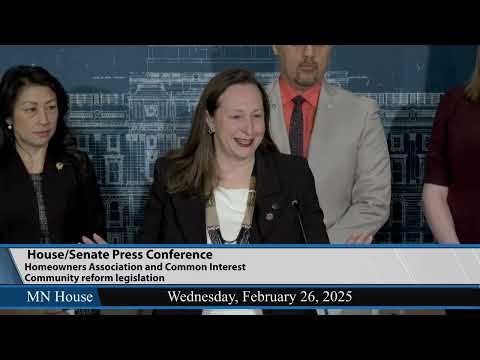
State Representative Kristen Bonner, chair of the legislative work group on common interest communities and homeowner associations, on Wednesday unveiled a proposed Master Common Interest Community and Homeowner Association policy reform bill intended to provide "consumer protections for homeowners and solid guardrails" for associations, boards and property managers.
The bill, developed from a 14-meeting work group and multiple public listening sessions, would set standards for governance, open meetings and governing documents; create clearer procedures for fines, fees and foreclosure; address conflicts of interest; and establish dispute-resolution frameworks intended to give homeowners an internal process to contest alleged violations and fees.
"The bill before you encapsulates the expertise of work group members and the experience of homeowners to spell out in plain language a common sense set of reasonable standards to improve Minnesota law," Representative Kristen Bonner said. She said the package is one of several bills lawmakers plan to move this session, including a separate proposal for attorney-general enforcement, a bill to create an office of an ombudsman and a task force to study insurance impacts on affordability.
Vice Chair Eric Lucero, who identified himself as a real estate agent and the Republican lead on the Senate Housing Committee, described homeowner complaints collected during listening sessions and from constituents. Lucero recounted a case in which a homeowner accumulated a $56 fine for a missed trash-can pickup while traveling, and "with that $56 the HOA board decided to initiate the foreclosure process." He also described an alleged conflict of interest in which an HOA steered roofing work to a contractor linked to its management company without competitive bidding.
Senator Susan Pye, who said she represents parts of Brooklyn Park, Brooklyn Center and Osseo, said the bill would require HOAs and common interest communities to "adopt procedures for dispute resolution, ensuring that no homeowner is left without the process to contest fines or violations." She added the bill would require associations to provide every unit owner with a written policy listing violations that can incur fines and a schedule of fines, and to give owners "reasonable time to correct the violation."
Representative Shane Mecklen, a licensed general building contractor who represents Becker and Big Lake areas, described multiple cases in his district in which homeowners were assessed major costs after shared septic systems were found noncompliant by the Minnesota Pollution Control Agency (MPCA). "Each and every 1 of these homeowners for anywhere from 23 to $28,000 have been assessed and they've been given 3 years to pay it at $900 a month," Mecklen said, adding that missing one payment could trigger foreclosure proceedings.
Lawmakers said the package also includes a provision (noted in the bill as Article 3) that would prohibit municipalities from conditioning approval of new developments on the mandatory formation of an HOA. Senator Rasmussen, who worked on that provision, warned that some cities "will condition permits on an HOA being granted, and they'll oftentimes use that as a way to regulate beyond what they would typically regulate," shifting costs from taxpayers to new homeowners.
Representatives and senators stressed the bill is the product of a bipartisan work group that included homeowners, boards, property managers, attorneys, industry groups and organizations that represent homeowners. Lawmakers said management companies and other stakeholders had seats at the table during the work-group process.
Several speakers noted the proposal is the lead piece of a suite of measures. Lawmakers said a separate bill hoped to expand AG enforcement of CIC/HOA rules, another would create an ombudsman office (carried by Senator Marty and Representative Mueller), and a third would create a task force to study insurance trends that lawmakers say are driving up costs for associations and homeowners. Representative Bonner said the ombudsman and enforcement bills carry budget implications and are being considered separately.
On process, lawmakers said they expect the Senate file (identified in remarks as Senate File 1750) to be assigned to the Senate Housing Committee with a hearing expected the following week, and then to proceed to state and local government and judiciary committees. On the House side, negotiators said discussions were ongoing with the House housing committee leadership, including Chair Howard and Representative Igoe, both listed as co-authors.
Supporters said the reforms aim to reduce homeowner confusion and costly litigation by clarifying roles, expectations and notice requirements for fines and governance. Critics and some stakeholders, they acknowledged, may not favor every provision; lawmakers said they welcome committee testimony and further refinement.
Lawmakers also said the proposal recognizes volunteer HOA board members and intends to provide a clearer framework to help volunteers succeed rather than set them up to fail. They said clearer rules and required communications (for example, published fine schedules and dispute procedures) could reduce conflicts by setting consistent expectations for owners and boards.
The bill does not itself include a comprehensive insurance solution, lawmakers said, which is why they plan a separate task force to study insurance affordability and its impact on reserve assessments, special assessments and overall housing costs.
No formal vote or enactment occurred at the event; lawmakers presented the proposal, took audience questions and described the path forward through committees.
Ending: Lawmakers said testimony in upcoming committee hearings will shape final language. They urged stakeholders to participate in committee hearings and indicated several related bills will accompany the master policy measure as the Legislature considers updated rules for CICs and HOAs this session.