Get Full Government Meeting Transcripts, Videos, & Alerts Forever!
Get email alerts on the School Safety topic
No spam. Unsubscribe anytime.
Minnesota lawmaker outlines 'Shield Act' to fund layered school safety systems statewide
Summary
Rep. Elliot Engen presented the Shield Act, a proposal to create a grant program to install layered safety systems in Minnesota schools; presenters described Lakeville's system and said the bill pairs physical measures with behavioral threat assessment and mental‑health supports. No formal vote was taken at the session.
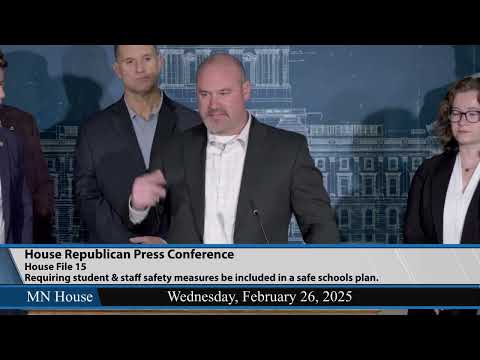
Rep. Elliot Engen (R‑District 36A) presented the Shield Act during a Minnesota legislative hearing, proposing a state grant program to install layered physical and communication systems in K‑12 buildings and pair those systems with behavioral threat assessment and mental‑health support.
Engen said the measure is intended as a bipartisan, non‑ideological approach to school safety. “I think right now we're dealing with an issue that seems to be politicized right away,” Engen said. “This bill is not about a gun debate.” He described working with school and public‑safety partners to model the proposal on systems used in Lakeville.
Jason Winski, a 29‑year police officer who previously served as a school resource officer in Lakeville, described the technical and operational approach behind the systems the bill would fund. “We focus on cover, concealment, and communication throughout the entire building, and we provide the innocent people those tools so they can respond effectively,” Winski said, comparing the approach to a fire suppression system that contains a threat and speeds response.
Mental‑health provider Michelle Fraunshoe, owner of Life Development Resources, said the bill is designed to link forensic‑level behavioral threat assessment and management to physical safety measures. “This is not a bill about hardening schools,” Fraunshoe said. “Every single one of the installments that we list here in this bill are completely naked to the human eye until you need them.”
A student who identified their school as Orchard Lake Elementary described a classroom drill: “I feel safe at school because we have the police button and whenever there's an intruder … someone would press the police button and we would all shut off the lights, be quiet, and go into a corner.”
Engen addressed cost questions from attendees and cited recent state budget figures while arguing the program is affordable. “We had an $18.5 billion surplus. We had that $10.5 billion in excess taxes on top of that,” he said, and noted a prior attempt to secure $100 million in funding did not get a committee hearing. He discussed potential revenue sources including long‑term facilities maintenance funds and existing safe‑schools dollars but said details must be worked out in committee.
Engen said he is working in concert with Rep. Mary Frances Clardy (D) and expects to refine eligibility and vendor‑selection language in committee to preserve bipartisan support. The bill would authorize a School Safety Center to determine eligible vendors; Engen said that is designed to limit opportunistic firms while allowing schools to choose qualified providers.
No formal motion or vote was recorded during the presentation; the session functioned as an informational briefing and question‑and‑answer period rather than a committee vote. Engen said the measure previously drew bipartisan co‑sponsors but did not receive a hearing last session.
Supporters emphasized the combination of physical systems, training, and behavioral threat assessment as complementary elements: the physical systems are intended to make rapid occupant response and officer intervention more effective, while mental‑health and threat‑assessment components aim to identify and support at‑risk students before incidents occur.
Next steps stated by presenters include drafting detailed grant eligibility language, specifying allowable expenditures and vendor qualifications, and seeking committee consideration. The timing for any committee hearing or formal legislative action was not specified during the session.