
Senate advances community care hub concept; authors seek $9.9 million to scale pilot
Get AI-powered insights, summaries, and transcripts
Sign Up Free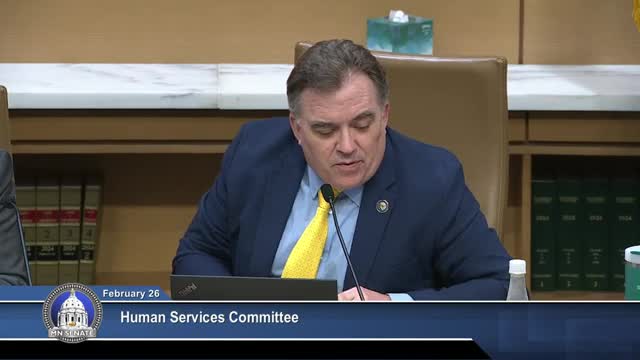
Summary
Sponsors and providers outlined Senate File 554, which would invest $9.9 million to expand community care hubs that coordinate social services with health care. Proponents said pilot models show measurable savings and better outcomes; the committee laid the bill over for possible inclusion in the omnibus package.
Senate File 554, which would establish and expand community care hub infrastructure, received testimony and an authors’ amendment in the Senate Human Services Committee on Feb. 20. The bill’s sponsors and providers said the hubs coordinate nonprofit social‑service providers with health‑care partners to prevent avoidable hospital and emergency use and to generate savings.
“Senate file 554 seeks an infusion of 9,900,000 to expand Minnesota's community care hub infrastructure,” Trellis strategist Mark Cullen told the committee, summarizing the proposal and citing pilot results from other states and Minnesota’s own Juniper program. Cullen said the hubs deliver social supports tied to clinical episodes—home modifications, chore services, meal delivery and fall‑prevention programs—that can reduce hospitalizations and downstream long‑term care costs.
Josh Berg, a board member involved with Trellis and Juniper, said the model aggregates hundreds of community organizations into a coordinated network and enables shared administrative platforms, data analysis and contracting so small nonprofits can participate sustainably. Cullen and Berg cited an example from North Carolina used in their analysis: at an estimated $85 of monthly savings per person, scaling the program to about 124,000 older Minnesotans in specific managed products could, by their math, yield roughly $126.48 million in annual savings.
Committee action: Senator Jim Abler moved the bill and the author’s A1 amendment; the amendment was adopted by voice vote and the bill was laid over. Chair Hoffman said the committee will consider how any captured savings could be reflected in future budget negotiations.
Context and caveats: Presenters emphasized the figures are modelled projections based on pilot data and may depend on how the state implements data sharing and payer arrangements. Committee members asked for fiscal office analyses and dynamic scoring to test the timing of savings, and some members noted potential opportunities to capture savings in future budget work.
Ending: The committee laid Senate File 554 over for further analysis and possible inclusion in the omnibus bill; sponsors said they will follow up with fiscal forecasts and implementation details requested by the committee.