Get Full Government Meeting Transcripts, Videos, & Alerts Forever!
Get email alerts on the Energy Tax Exemption topic
No spam. Unsubscribe anytime.
Committee advances bill to extend year-round sales-tax exemption to residential electricity and natural gas
Summary
House File 9, presented by Representative Swazinski, would extend Minnesota’s year-round sales-tax exemption for residential heating fuels to include electricity and natural gas; the committee approved sending the bill to Ways and Means after Representative Gomez withdrew an amendment that would have redirected the revenue to LIHEAP.
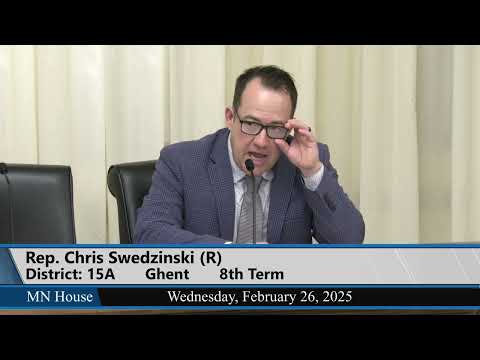
House File 9, presented to the House Tax Committee by Representative Swazinski, would add electricity and natural gas sold for residential use to Minnesota’s existing year-round sales-tax exemption for residential heating fuels. The committee voted to send the bill to the House Ways and Means Committee.
The bill’s tax provision — appearing on pages 5.13 through 5.24 of the draft — would extend the long-standing sales-tax exemption that already covers fuel oil, coal, wood, steam, hot water, propane and LP gas to residential electricity and natural gas, making those utilities exempt from sales tax year-round for residential heating use.
Fiscal impact: House fiscal staff and nonpartisan estimates distributed to members indicated the change would reduce state sales-tax receipts by about $109,000,000 per year (nonpartisan figure cited during the hearing). Representative Swazinski described the proposal as an attempt to relieve Minnesotans of a regressive sales-tax burden on foundational household energy use.
Amendment and debate: Representative Gomez offered an A11 amendment that would have redirected the fiscal value of the proposed exemption to the Low Income Home Energy Assistance Program (LIHEAP) if federal LIHEAP funds did not materialize. Gomez argued the amendment would better target assistance to low-income households; Representative Swazinski urged members to vote no on that amendment, saying it represented an unwarranted redirection of tax policy and that letting taxpayers keep their dollars is preferable.
Representative Gomez withdrew the A11 amendment after discussion; she said the amendment’s intent was to protect low-income energy consumers and cited distributional data showing higher-income households receive a disproportionate share of the proposed exemption’s benefits.
Committee action: After the A11 amendment was withdrawn, the committee voted to send House File 9 to Ways and Means. There was no roll-call vote recorded in the transcript for the final motion to refer; the chair called the voice vote and declared the motion prevailed.
Quotes from the hearing: Representative Swazinski said the measure is “our attempt for a lights on bill” and emphasized that the committee would focus on the tax portions affecting residential heating fuels. Representative Gomez described the A11 amendment as an effort to “focus it on the Low Income Home Energy Assistance Program” and to ensure dollars target Minnesotans most affected by high energy bills.
Next steps: House File 9 will be considered by the House Ways and Means Committee where the bill’s fiscal impacts and policy details will receive further review.