Get Full Government Meeting Transcripts, Videos, & Alerts Forever!
Get email alerts on the Parks And Trails Legacy Fund topic
No spam. Unsubscribe anytime.
Minn. legacy fund leaders brief committee on parks, trails, accessibility and maintenance concerns
Summary
Metropolitan Council, DNR and Greater Minnesota commission told the Legacy Committee how Parks and Trails Legacy Fund dollars support land acquisition, rehabilitation, programs and accessibility — and committee members pressed on long‑term maintenance funding.
Chair McDonald convened the Legacy Committee for a briefing by three park and trail partners on the Parks and Trails Legacy Fund, the long‑term plan it supports and recent projects across Minnesota.
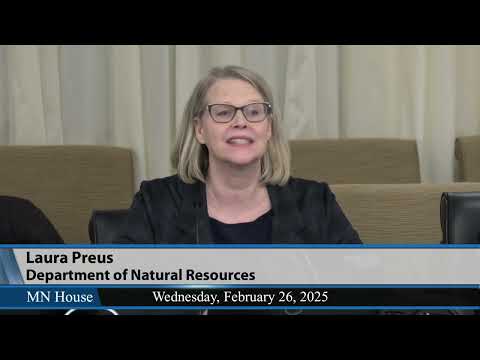
Lisa Varjas, Executive Director of the Community Development Division at the Metropolitan Council, Laura Pruis, Statewide Program and Planning Manager with the Department of Natural Resources’ Division of Parks and Trails, and Renee Mattson, Executive Director of the Greater Minnesota Regional Parks and Trails Commission, described how legacy dollars are being used for land acquisition, trail and facility rehabilitation, public programs and accessibility initiatives.
The partners said legacy money has enabled acquisitions, programming and repairs that local governments and agencies could not have funded alone. “Legacy funds have been a game changer,” Laura Pruis said, describing investments ranging from renovated trail bridges in Minneapolis to new campground sites on the North Shore.
The presenters summarized how the fund was created and how dollars are distributed. They reminded the committee that voters in February 2008 approved the Clean Water, Land and Legacy Amendment, a 3/8 of 1% state sales tax increase dedicated to four funds. The Parks and Trails Fund is the smallest of those four funds and, according to Varjas, supports statewide and regional parks and trails through a combination of formula distributions and targeted land‑acquisition dollars.
Metropolitan Council staff explained the metro distribution formula: roughly 90% of metro legacy dollars are distributed by a statutory formula to 10 regional park implementing agencies (based on acreage, population served, visitor numbers and operating cost) and 10% is reserved for land acquisition. Varjas described recent metro system statistics: the metropolitan regional parks and trails system comprises dozens of parks and nearly 500 miles of regional trails, protecting more than 65,000 acres; a 2023 visitation estimate cited more than 69 million visits to the regional system.
The DNR outlined state park and trail numbers and programs it supports with legacy funding: 73 state parks and recreation areas covering roughly 240,000 acres, 25 state trails and an extensive grants and volunteer program. Pruis highlighted the I CAN skill‑building programs, a pilot library pass program that lets library patrons check out a seven‑day state park access pass, and interpretive programs aimed at introducing new users to outdoor recreation.
Mattson described the Greater Minnesota Commission’s role in designating regionally significant facilities (about 80 designated facilities) and in directing a portion of the Greater Minnesota share of legacy funds to communities across 80 counties. She outlined grant programs for equipment, “track” wheelchairs and accessibility upgrades, and noted the commission’s recent decision to hire an accessibility expert to run a series of public forums for park professionals.
Committee members focused most of their questions on maintenance and operations costs. Representative Heintzeman pressed the presenters on long‑term, recurring maintenance, saying the committee must “figure out a way to maintain this infrastructure” to avoid higher rehabilitation costs later. Pruis and Mattson said legacy funds are used largely for rehabilitation, land acquisition and targeted programs rather than routine operations; they said applicants must demonstrate realistic operations and maintenance plans when requesting legacy capital grants. Pruis noted the DNR received $1 million in general funds to expand preventive crack sealing because that routine work saves money over the long term.
Other topics raised during Q&A included the distribution of funds for motorized and non‑motorized trails, examples of equipment grants (mobile mountain bike fleets and track wheelchairs), free equipment‑use days required by some grants, library park pass pilots, and efforts to measure program outcomes and visitor behavior.
The presenters and committee members repeatedly framed legacy as a complementary source alongside other dedicated accounts (for example, snowmobile or ATV grant‑and‑aid accounts) and local revenue. They warned that legacy dollars alone are not intended to cover ongoing routine maintenance and that long‑term stewardship will require coordination among local governments, agencies and the Legislature.
The committee did not take formal action on policy or funding during the session; a routine motion to approve the minutes was moved by Representative Heintzeman and carried.
Looking ahead, the testimony emphasized three priorities: protecting and acquiring key lands and trail corridors; using legacy money for rehabilitation and programmatic work that connects new users to the outdoors; and addressing gaps in maintenance funding and planning to keep the system in usable condition over time.