Get Full Government Meeting Transcripts, Videos, & Alerts Forever!
Get email alerts on the Kensington Revival Plan topic
No spam. Unsubscribe anytime.
Philadelphia council committee hears year‑end report on Kensington Community Revival Plan
Summary
Philadelphia City Council’s special committee on Kensington convened a hearing to evaluate the year‑end report on the Kensington Community Revival Plan after Mayor Parker announced a five‑phase initiative; city officials described declines in shootings and homicides in 2024 and new programs including a neighborhood wellness court, a Riverview recovery campus and a public dashboard.
Philadelphia City Council’s special committee on Kensington held a hearing to review the year‑end progress report on the Kensington Community Revival Plan and to question city officials about next steps and remaining gaps. City public‑safety leaders told the committee that concentrated law‑enforcement operations, newly funded community grants and new treatment and shelter capacity corresponded with substantial reductions in shootings and homicides in the Kensington footprint in 2024, and city staff unveiled a public dashboard intended to show progress across public safety, health and quality‑of‑life measures.
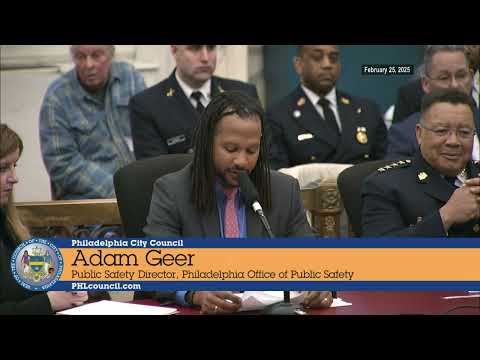
The hearing, convened under Resolution 24119, brought testimony from Chief Public Safety Director Adam Geer; Philadelphia Police Commissioner Kevin Bethel; Deputy Commissioner Pedro Rosario; and Kristen Bray, counsel to Mayor Parker and director of the city’s performance office, Philly Stat 360. Officials described a mix of enforcement, outreach and service expansions intended to stabilize the neighborhood and to funnel people into treatment and housing resources.
Philly Stat 360 dashboard and administration claim of progress
Kristen Bray told the panel that the administration launched a Kensington Community Revival Plan dashboard to make key metrics public. "Today, I'm excited to formally introduce to City Council the Kensington community revival dashboard," she said, describing interactive maps of police districts, encampment resolutions, cleanups, needle pickups and behavioral‑health and shelter bed counts.
Adam Geer, the city’s chief public safety director, said the administration had created new offices and coordinated multiple departments and partners to pursue a five‑phase plan the mayor announced after inauguration. "We will not accept the status quo. We will not turn a blind eye. We are gonna roll up our sleeves and dig in shoulder to shoulder with the community," Geer said, and he cited the administration’s assessment that "in 2024, both homicides and shootings were down by over 40 percent in Kensington." Geer also told the committee the city had awarded grants and stood up programs, including a new wellness support center and a neighborhood wellness court pilot.
Police statistics and enforcement measures
Deputy Commissioner Pedro Rosario described an enforcement focus concentrated on a roughly 15‑by‑12 block area that the panel and police labeled the Kensington grid. He said narcotics investigators moved into the footprint in March and later expanded deployments; the department reported seizing large quantities of fentanyl and firearms and making hundreds of arrests. "We recovered 87 firearms" in the mini‑station area, Rosario said in his presentation, and he also referenced larger East Division totals including the removal of "$24,000,000 worth of fentanyl" and millions of doses seized when broader narcotics work was included.
Rosario and other speakers emphasized a combined strategy: stepped‑up policing and specialized narcotics investigations, expanded patrol staffing at a Kensington mini‑station, a drone responder pilot for rapid incident assessment, and an interdepartmental nuisance‑fire task force. The police reported increases in arrests in the East Division in 2024 for both buyers and sellers of drugs (Rosario cited roughly a 3:1 buyer:seller arrest ratio as typical of street investigations).
New and expanding services: wellness court, Riverview Wellness Village, beds and grants
Officials described service expansions aimed at diverting people into treatment and shelter. Geer and Rosario highlighted a new Kensington Neighborhood Wellness Court pilot offering same‑day assessments and coordinated intake into treatment, and a new Kensington Wellness Support Center that houses police‑assisted diversion and walk‑in services.
Deputy Managing Director Crystal Yates‑Gail and Amanda David of the Department of Behavioral Health and Intellectual disAbility Services (DBHIDS) discussed Riverview Wellness Village, a new campus the administration opened to provide longer‑term recovery housing and on‑site health care. DBHIDS described the referral pathway to Riverview from treatment programs using a Recovery House referral form; officials said one wing holds 44 beds and that one wing was nearing capacity while additional wings would open to expand female beds. DBHIDS also said it had 37 referrals to Merakey for review and intake.
Geer and other administration officials described grant investments that the Office of Public Safety distributed in 2024: $8,600,000 in violence‑prevention grants to 19 community organizations and $3,500,000 to 77 organizations for overdose prevention and community resilience. Officials also said the Office of the Victim Advocate had deployed a crime‑scene cleanup pilot 59 times.
Questions from council and requested follow‑up
Council members pressed officials on displacement, bed visibility and data, and the pace and scope of treatment referrals.
Chairperson Lozada (Special Committee on Kensington) and Councilwoman Nina Ahmad repeatedly raised displacement concerns after encampment resolutions, asking how the administration would respond when outreach or enforcement actions moved people to adjacent blocks. Geer acknowledged displacement and said the administration is working to expand services and the neighborhood wellness court pilot to reduce the likelihood people are simply displaced; he told the committee the court pilot was only weeks old.
Kristen Bray and Philly Stat 360 staff said the new dashboard draws from multiple departments and that some data streams are more real‑time than others. Bray said bed data are reported daily now and that the administration is working toward near real‑time bed tracking on the dashboard.
Council members asked for specific follow‑up and data the administration agreed to provide or to produce promptly, including: - counts and breakdowns of retail/theft and related referrals (police said they would provide those numbers the next day); - a fuller plan and accounting for opioid settlement expenditures (administration said it was developing budget and allocation plans and would report back); - operating budget and placement numbers for Riverview Wellness Village (officials said they would share operating budget figures and fuller referral counts); - more granular referral and post‑placement tracking to evaluate whether outreach placements result in sustained connections to services (officials said HIPAA and privacy constraints limit individual case disclosure but that the administration is building aggregate evaluation into dashboards and reporting).
Community testimony: pace, coercion and harm‑reduction critics
Three community speakers who testified during public comment offered contrasting perspectives. Al Klosterman, a Harrogate Civic Association member, said the "rate of progress has just been too slow" and urged expansion of wellness court and patrols in parts of his neighborhood.
Leah Shepherd, who said she co‑parents children who lost fathers to overdose, criticized coerced treatment models and cited research she said shows limited evidence that coercion improves outcomes: "the evidence showing that coerced treatment works ... is very limited," she said, and urged voluntary pathways and caution about increased policing.
Harm‑reduction advocate Kateri Andriole told the committee she believed policing and forced clearances have harmed the unhoused and people who use drugs, adding: "Viewing the empty streets of Kensington as a success is nothing but violent naivete." Chair Lozada responded that the committee’s stated aim is to expand both services and public‑safety responses and to prioritize residents' quality of life.
What the hearing produced and next steps
The hearing produced a public demonstration of the new Philly Stat 360 dashboard and a set of near‑term follow‑ups the administration agreed to deliver to council: more detailed counts on arrests and charging outcomes, a clearer plan for opioid settlement spending and budget offsets, more precise bed‑tracking and referral reporting for Riverview and other treatment sites, and continued interagency work on nuisance‑fire responses and business corridor supports. Officials emphasized the pilot nature of the neighborhood wellness court and said they would scale or adjust operations as they collect early performance data.
The administration repeatedly cautioned that substantial problems are long‑standing and that the work will take more than a single budget year to show durable neighborhood‑wide changes. Council members, community speakers and police leaders said they would continue to monitor performance metrics and pressed for more transparency on outcomes beyond initial arrests or placements.
Ending
Committee members said they will meet again and review the requested data. The committee also scheduled follow‑up hearings on diversion and related programs. The administration reiterated its stated goals of reducing open‑air drug markets, improving public safety and increasing treatment and shelter capacity, while council members and community speakers said they would judge success by whether residents could "see, touch and feel" sustained improvements in neighborhood quality of life.