Get Full Government Meeting Transcripts, Videos, & Alerts Forever!
Get email alerts on the City Finance topic
No spam. Unsubscribe anytime.
Council hearing on Resolution 240886 highlights fiscal risks, PICA urges larger reserves
Summary
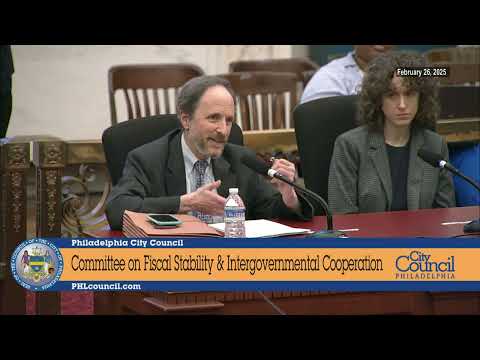
The Committee on Fiscal Stability and Intergovernmental Cooperation held a public hearing on Feb. 18 to consider Resolution 240886, which would require quarterly hearings and monthly reporting on the city's fiscal position, five-year plan and social-impact goals.
The Committee on Fiscal Stability and Intergovernmental Cooperation held a public hearing on Feb. 18 to consider Resolution 240886, which would authorize the committee to hold quarterly hearings with monthly reporting requirements on the city's fiscal position, five-year plan and related social-impact goals. Testimony came from Rob Dubow, the city's finance director; Sabrina Maynard, the city's budget director; and Marissa Goran Waxman, executive director of the Pennsylvania Intergovernmental Cooperation Authority (PICA).
"We are testifying before you at a time of heightened risk for the city's finances," Dubow told the committee, citing the end of roughly $1.4 billion in COVID relief funds and uncertainty about federal grant levels and timing. He said federal grants totaled about $2.8 billion in FY24 and that changes in federal policy or funding could reduce or delay grants the city expects to receive.
Why it matters: City officials and PICA emphasized that reduced or delayed federal funding and possible job losses at medical, educational and government institutions would hit wage-tax collections and could widen budget shortfalls. The testimony described a fund-balance and reserve picture that municipal officials called better than some internal goals but well below widely cited benchmarks.
The city's most recent quarterly city manager's report projects an FY25 year-end general fund balance near $580 million (the QCMR gave an updated figure of about $584 million), a level Dubow said is roughly 9% of revenues. He contrasted that with the Government Finance Officers Association (GFOA) guideline of about 17% of revenues. "We have also built up a budget stabilization reserve fund," Dubow said, adding that the administration set aside an $80 million reserve in the midyear against potential federal funding changes.
PICA's view: Marissa G. Waxman said PICA exists to monitor and strengthen the city's fiscal condition and warned that recent federal announcements increase fiscal uncertainty. "PICA is the city's fiscal lifeguard," she said, summarizing PICA's role reviewing the five-year plan and monitoring indicators such as reserves, pensions and debt. Waxman noted the city's improvements over recent years but said several indicators still raise concern: operating surplus/deficit, funded pension ratio, change in fund balance, fund balance as a percent of revenues, and total reserves for unanticipated conditions.
PICA cited a change in the FY25 projection: the city initially planned to spend about $96 million more than expected revenues but now projects a significantly larger shortfall in FY25; PICA's testimony referenced an updated FY25 operating deficit of about $395 million. Waxman urged building reserves and improving budget detail for new initiatives so the city can manage contingencies without abrupt service cuts.
Council questions and administration responses: Councilmembers pressed officials on several specifics. Councilmember Kathy Gilmore Richardson asked how vacancy assumptions affect the reported fund balance, especially in public safety. Dubow and Maynard said the administration uses an increased vacancy allowance and plans budgets on the assumption some positions will remain unfilled for parts of the year; they acknowledged staffing underspends have been a persistent driver of higher fund balances in recent years. Councilmember Gilmore Richardson also cited roughly 1,400 police vacancies when questioning how realistic near-term hiring goals are.
Maynard outlined components of midyear increases the administration included in the QCMR: a proposed $225 million of additional midyear spending (the largest piece being the increased reserve noted above), and separate allocations for 2026 event preparations and investments in prisons and wellness centers. Maynard said the wellness center package includes operating contracts and a capital PAYGO component; she described an operating component of about $35 million and a PAYGO capital component of about $30 million associated with the managing director's portfolio.
Council members also raised revenue questions. Dubow and Maynard said transfer-tax receipts have moderated after a pre-abatement rush to market and that business-income and receipts tax revenues can be difficult to project because filings arrive later in the fiscal year. Councilmember Curtis Jones asked how the current surplus compares to prior years; Dubow said FY24's fund balance was about $942.9 million and that current projections are lower than the recent highs but remain above the administration's internal target.
Other budget topics: The hearing reviewed the soda (beverage) tax and its use for the Rebuild program. Rob Dubow said beverage-tax receipts are projected at about $65.7 million for the year; some of that revenue is already committed to childcare/pre-K programs and to debt service for Rebuild bonds. Councilmembers asked why the city borrows to finance Rebuild projects instead of paying cash; Dubow explained borrowing spreads costs over the useful life of capital projects and aligns payments with long-term benefits.
Tax and assessment issues came up as well. Councilmembers discussed the city's assessed value increases after property reassessment (AVI) and asked whether broader millage relief or continued targeted programs (homestead, low-income freezes, other relief) better protects lower-value homeowners. Dubow and Maynard described the administration's preference for targeted relief under state law constraints.
Next steps and resolution: Resolution 240886 would institutionalize the committee's quarterly hearings and the monthly reporting the committee sought to review. Officials from the administration and PICA offered to continue to provide analysis and requested that council and the administration remain "thought partners" as the FY26 budget and the FY26'FY30 plan are developed. The committee concluded the hearing after receiving questions from members and testimony from the two panels.
What was not decided: The hearing was informational; no committee vote on the resolution or other legislative actions was recorded during the public testimony. Officials frequently described proposals and budget requests that council has not yet legislated or approved (for example, wellness center contract funding and some midyear allocations), and those items remain subject to subsequent council action.
Contact and follow-up: Committee members asked for additional detail on several items, including a department-level breakout of some midyear spending, the split of beverage-tax receipts by program and debt service, and an analysis of what it would take to shift the city from its current budgeting model toward a zero-based budgeting approach. The administration and PICA said they would provide follow-up materials and further analysis as council considers the FY26 budget and five-year plan.