Get Full Government Meeting Transcripts, Videos, & Alerts Forever!
Get email alerts on the Behavioral Health Budget topic
No spam. Unsubscribe anytime.
DLS flags shortfalls, recommends cuts and reporting changes in Behavioral Health Administration budget
Summary
The Department of Legislative Services presented an analysis of the Behavioral Health Administration budget showing overall growth driven by Medicaid provider reimbursements but recommending several reductions and annual reporting requirements; the Maryland Department of Health responded with clarifications and partial disagreements.
The Department of Legislative Services (DLS) told the Health and Social Services Subcommittee on Appropriations that the fiscal 2026 allowance for the Behavioral Health Administration (BHA) increases overall but contains specific areas DLS recommends reducing or clarifying.
DLS analyst Naomi Kimura said the fiscal 2026 allowance includes roughly $3,400,000,000 for vendor/provider reimbursements, an increase of about $83,000,000 over the current year, and highlighted that provider reimbursements represent the largest share of BHA's budget. DLS noted the fiscal 2026 allowance includes $19,500,000 for a 1% provider rate increase across three reimbursement programs but recommended deleting that increase given the State’s fiscal situation. DLS also recommended several targeted reductions, including a $9,000,000 reduction in fiscal 2025 state-funded Medicaid services and a $9,900,000 general-fund reduction tied to investments it judged likely billable to Medicaid.
Kimura summarized DLS’s other concerns: a proposed $149,000,000 deficiency related to a behavioral health Medicaid shortfall in fiscal 2025, planned reversions and withdrawals totaling tens of millions of dollars, limitations in the data available to forecast non‑Medicaid behavioral health programs, and outstanding questions about transfers proposed in the budget reconciliation and financing act (BRFAA). DLS requested annual committee narrative and data from MDH to improve forecasting of utilization and enrollment for non‑Medicaid programs.
Deputy Secretary Alyssa Lord, representing the Maryland Department of Health (MDH), told the subcommittee the department disagrees with some DLS recommendations. Lord said the department still needs state opioid restitution funds (ORF) dollars to cover the state share of services despite CMS waiver approval that allows federal match for MOUD services in correctional settings. On the recommended deletion of the 1% provider rate increase, MDH acknowledged the fiscal pressures but said the Governor’s budget includes the increase to support provider adequacy. MDH also asked the committee to preserve flexibility to realign funding within Medicaid and related programs to avoid halting provider payments should costs exceed projections.
DLS recommended releasing restricted funds tied to the ASO reconciliation report so long as no objections are raised by the subcommittee. MDH responded it supports releasing $250,000 that had been restricted pending the report but disagreed with several DLS proposed restrictions on budget realignments and sought clarification on some DLS contract‑cost calculations.
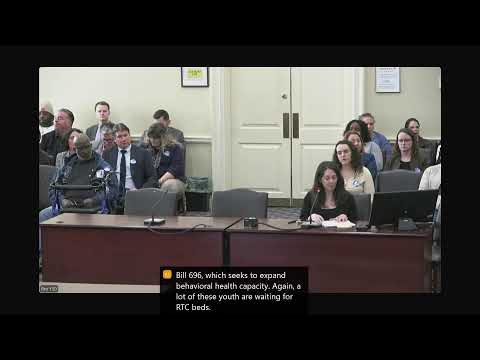
The subcommittee heard multiple follow‑up questions from members about workforce shortages, forecasting, the accounting of federal and special funds, and the status of several programmatic initiatives. The hearing concluded with a series of advocacy testimonies urging restoration or protection of specific BHA line items, including 988 funding, mobile crisis teams, pediatric crisis services and CCBHC implementation funding.
DLS recommendations and MDH responses remain before the subcommittee; no formal votes were recorded during this hearing.