Get Full Government Meeting Transcripts, Videos, & Alerts Forever!
Get email alerts on the Insurance Reinsurance Study topic
No spam. Unsubscribe anytime.
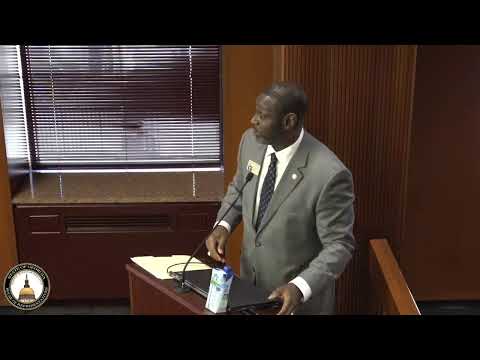
Rep. Douglas asks committee to study reinsurance fund to help small businesses and essential industries
Summary
Representative Douglas presented House Resolution 40 proposing a study committee to explore a state-backed reinsurance model—modeled on Section 1332 waiver tools—to attract reinsurers and reduce coverage gaps for small businesses across industries, with extended Q&A clarifying reinsurance mechanics and scope.
Representative Douglas presented House Resolution 40 to the Committee on Special Rules, proposing a study committee to examine how the state could attract reinsurance capacity to backstop insurers covering small businesses and “essential” industries.
Douglas described the committee’s purpose: to identify industries most challenged by insurance limits, to measure economic impact using Georgia Department of Economic Development metrics, and to design public-private partnerships that could attract reinsurers to reduce premiums and transfer risk. “The study committee will measure economic impact using the same, same thing as a Georgia Department of Economic Development,” Douglas said.
He explained the concept with an example involving timber: if a timber owner’s inventory is worth $2,000,000 but the insurer covers only $1,000,000, reinsurance could allow the insurer to extend coverage so the owner is not left with an uncompensated loss. Douglas characterized the model as similar in structure to the state’s prior use of a Section 1332 Medicaid waiver mechanism for program design, with the Georgia Department of Insurance calculating reinsurance payments for participating issuers. He named reinsurance firms he said commonly operate in the market, including Swiss Re, Hannover Re, Canada Life and Berkshire Hathaway.
Committee members asked multiple clarifying questions. Representatives asked whether reinsurance functions like an umbrella policy, whether reinsurers are licensed in Georgia, and whether the proposal would apply beyond agriculture. Douglas said the committee would examine commercial property and casualty markets and that the model would target small businesses across industries, including agriculture and timber, not just one sector. He emphasized reinsurers back insurers rather than paying claimants directly.
Members repeatedly sought clarity on why insurers might limit coverage, how reinsurance pricing and backing operate, and whether participation would be optional; Douglas and the chair discussed premium tradeoffs and the role of reinsurance as a backstop. A member used a hurricane example to illustrate that insurers rely on reinsurers to cover widespread catastrophic claims.
No committee vote or formal directive to staff was recorded in the hearing. The resolution was presented for study; next steps and timelines for the proposed study committee were not specified in the transcript.