Get Full Government Meeting Transcripts, Videos, & Alerts Forever!
Get email alerts on the Election Law topic
No spam. Unsubscribe anytime.
Revenue Committee advances bill to prohibit ranked‑choice voting after extended debate
Summary
The Revenue Committee advanced House Bill 165, a measure that would ban ranked‑choice voting in government-administered elections; testimony produced divided views on voter access, implementation costs and legal reach, and the committee recorded a roll-call vote with inconsistent tallies announced on the record.
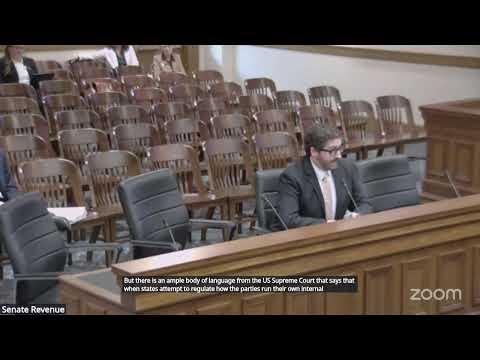
After more than an hour of testimony and debate, the Revenue Committee voted to advance House Bill 165, which would prohibit ranked‑choice voting in elections administered by government entities in the state. Sponsors presented the measure as a proactive clarification; opponents said it forecloses local experimentation and could raise constitutional questions if it reaches outside government-run elections.
Representative Joe Webb, the bill sponsor, described ranked‑choice voting (RCV) as a system that lets voters rank candidates and then conducts multiple rounds of tabulation until a candidate achieves a majority. Webb said the bill is “pretty simple and straightforward” and read statutory language intended to make RCV void in Wyoming elections.
Testimony for and against the bill was extensive and split. Joe Rubino, policy director and counsel for the secretary of state, and Secretary of State spokespersons said the secretary supports the prohibition and that the measure follows language used in other states. Rubino and Secretary Gray cited concerns about ballot exhaustion and tabulation complexity, and characterized the bill as a proactive step to preserve consistent election administration.
Opponents urged caution. Senator Case and others argued the committee was banning a method that state law currently does not allow to be used without additional enabling action, and they urged more study. Senator Case called instant‑runoff voting (another name for RCV) a familiar preference method and said it “works really well” in some jurisdictions. Ben Williams of FairVote Action proposed a narrow amendment—insert the words “government administered” before “election”—to make clear the ban would not apply to private party nominating procedures; proponents of the bill opposed that amendment and the committee rejected it.
County clerks' testimony focused on implementation. Mary Langford, representing Wyoming’s county clerks, said existing tabulation equipment can collect ranked ballots but that the algorithm/software required to perform RCV tabulation would require contracting with third‑party vendors; Langford noted no EAC‑certified vendor for that software was available and raised security and certification concerns.
Public‑interest and advocacy groups also differed. Gail Simmons (Civics307 and Y Vote) and Marissa Carpio (Equality State Policy Center) said RCV is unnecessary in many Wyoming races and urged either rejection or that local options remain available. Jackie Dwyer (Honest Elections Project Action) and Brett Mullen (Wyoming Farm Bureau Federation) urged the committee to advance the prohibition, citing tabulation issues and public confidence concerns observed elsewhere.
The committee took a roll‑call vote. During the vote the clerk read individual responses (Senator Case—No; Senators French, Eyde, and Pappas—Aye; Chairman McEwen—Aye) and initially announced “4 aye and 1 no.” The clerk then stated a correction on the record—“that would be 3 aye and 2 no”—creating an inconsistency in the transcript about the final tally. The chairman declared the bill advanced from committee despite the announced correction. The record includes both the verbal roll-call responses and the clerk’s subsequent correction; committee staff may be asked to confirm the official tally before floor action.
The bill will proceed from the Revenue Committee toward further legislative consideration.