Get Full Government Meeting Transcripts, Videos, & Alerts Forever!
Get email alerts on the Human Trafficking Prostitution Definition topic
No spam. Unsubscribe anytime.
Senate Judiciary Committee advances bill expanding prostitution definition to aid trafficking investigations
Summary
The Wyoming Senate Judiciary Committee voted to “do pass” House Bill 62, which adds a category of sexual contact to prostitution statutes to give law enforcement an initial criminal basis to investigate illicit massage businesses and human‑trafficking operations, supporters said.
The Wyoming Senate Judiciary Committee voted to recommend passage of House Bill 62, a measure that would add a definition of "sexual contact" to the state's prostitution statute to give law enforcement what proponents described as an initial crime to investigate illicit massage parlors and human‑trafficking operations.
Supporters told the committee the change is targeted at covert commercial sex enterprises often operated by traffickers. Representative Heiner, who carried the bill in the House this year, told the committee the proposal mirrors language used in assault statutes and narrows the definition to conduct done for money or other property. "It has to be for money or other property to constitute prostitution," Representative Heiner said, explaining why the change would apply to commercial enterprises rather than private, consensual contact.
The bill would add a definition of "sexual contact" and incorporate that definition into the human‑trafficking provisions described as Article 7 in testimony. Kara Chambers of the Wyoming Attorney General's Office, Division of Victim Services, said the Human Trafficking Task Force brought the issue to the department after encountering cases where current statutes did not provide an initial offense for investigators. "This has ... arose out of the Human Trafficking Task Force," Chambers said, adding she was available to answer technical questions.
Several witnesses with law‑enforcement and victim‑service backgrounds described patterns investigators encounter in illicit massage parlors. Terry Markham, executive director of Uprising, a statewide anti‑trafficking nonprofit, said traffickers frequently hold workers in debt bondage, with victims often coming from Southeast Asia and being moved frequently to avoid detection. "The illicit massage parlor industry is basically one giant organized crime ring," Markham said, summarizing field experience that, he said, illustrates why investigators need an initial criminal predicate to enter and pursue broader offenses such as money laundering or racketeering.
Other public witnesses included Justin Scott, a former sheriff's office task‑force leader who described law enforcement experiences in neighboring states, and Alan Thompson, executive director of the Wyoming Association of Sheriffs and Chiefs of Police, who said the bill takes a definition from the sexual‑assault statutes and applies it to prostitution to assist street‑level enforcement.
Opponents did not appear in force during the committee hearing. Several senators questioned particulars of the statutory language and whether definitions should remain consistent across the criminal code; supporters said the House made minor adjustments but that the bill would still allow investigators to pursue traffickers while state human‑trafficking protections prevent criminal liability for victims.
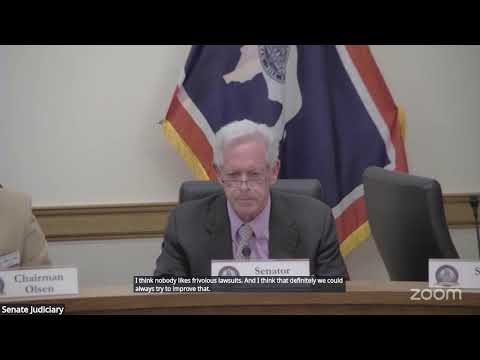
After public testimony and committee discussion, Senator Crago moved the bill. The committee conducted a roll‑call vote: Senator Crago — aye; Senator Crum — absentee aye; Senator Cope — aye; Chairman Olsen — aye. Senator Hicks was excused. The clerk announced "Do pass."
The committee record shows the action as a recommendation to the full Senate; the bill will proceed according to the Senate's calendar and rules.
Notes: The bill's proponents and witnesses repeatedly framed the change as an enforcement tool aimed at trafficking networks rather than prosecution of trafficking victims. The transcript records references to the state's human‑trafficking provisions (described as Article 7) and to an assault statute cited as "62,301," which supporters said supplies the definition moved into the prostitution chapters.