Get Full Government Meeting Transcripts, Videos, & Alerts Forever!
Get email alerts on the Federal Transportation Review topic
No spam. Unsubscribe anytime.
U.S. DOT review process adds new layer to Lexington MPO planning; staff told to avoid terms including 'environmental justice' and 'equity'
Summary
MPO staff briefed the Lexington Area Transportation Policy Committee on new U.S. Department of Transportation review requirements that may subject MPO documents and amendments to additional review and prohibit the use of several terms in federally funded documents; Title VI remains in force.
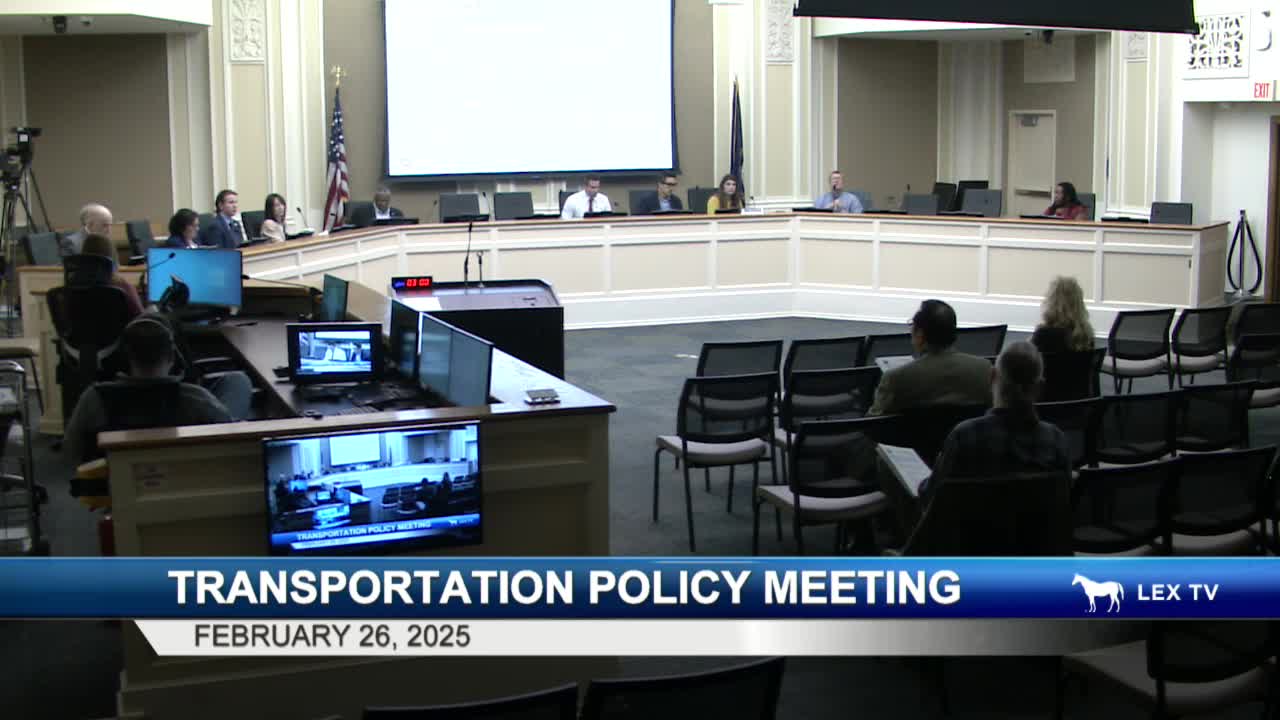
Chris Avila, a planner with the Lexington area MPO, told the Transportation Policy Committee that the U.S. Department of Transportation has begun a new review process that may apply to MPO actions including Transportation Improvement Program (TIP) amendments, the Unified Planning Work Program (UPWP) and certain certification and air-quality determinations.
Avila said the federal review is an added layer to existing FHWA processes and that U.S. DOT notified MPOs of the review last week; subsequent guidance from the Kentucky Transportation Cabinet (KYTC) arrived the morning of the meeting. He said some actions already in the TIP and previously adopted documents can proceed for now, but new projects or “significant changes” to transportation facilities likely will be subject to review.
MPO staff emphasized why the change matters: the review could delay approvals and affect when MPO work is eligible for federal reimbursement. Avila said the MPO traditionally must have FHWA sign-off before July 1 for work to be eligible for reimbursement in the new fiscal year; he said it is unknown what will happen if a UPWP or other document remains under review at that date.
Avila also outlined specific changes that KYTC, following recent federal guidance, instructed MPOs to implement immediately. According to the guidance staff received, documents produced using federal funds should no longer use the terms “environmental justice,” “transportation equity,” “climate change,” “energy impacts,” “greenhouse gas emissions,” “Justice40,” or references to the Council on Environmental Quality. Avila said Title VI of the Civil Rights Act remains in effect and was not replaced by the guidance.
Avila raised several outstanding questions: which DOT office will do the reviews (Office of General Counsel in Washington, D.C., a regional division office, or another office), how long reviews will take, how many national actions will be subject to review (he estimated the nationwide total could be in the thousands), and what remedies or corrective steps the federal government may require if a document is found to be inconsistent with administration priorities.
Committee members asked for documentation staff could carry to meetings with members of Congress and for a clearer record of which existing projects must be revisited. Avila reminded the committee that staff roles are federally funded and that federal law limits the use of federal dollars for lobbying; staff said they will provide briefings to committee members who choose to speak with congressional offices.
Avila said MPO staff are proceeding “as if nothing has changed” because the department has stated there is no official pause, but they are reviewing draft documents (including a TIP amendment scheduled for the meeting and a FY26 UPWP draft planned for submittal the next day) to reduce language that could trigger a federal review. He said staff rescored local project applications, removing equity and greenhouse-gas criteria where required, and that rescoring did not change the recommended projects in the current round.
Avila and committee members agreed to keep the committee updated as federal and state guidance evolves.