Get Full Government Meeting Transcripts, Videos, & Alerts Forever!
Get email alerts on the Fairness In Sports topic
No spam. Unsubscribe anytime.
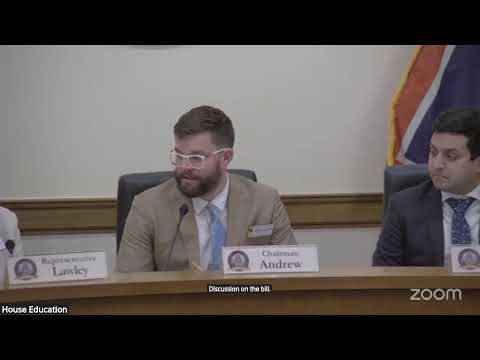
House Education Committee gives do-pass to bill limiting collegiate competition to sex at birth
Summary
The Wyoming House Education Committee voted 9-0 to advance Senate File 44, a bill that would restrict intercollegiate athletic competition to the sex listed on a student’s birth record and creates a private cause of action and enforcement provisions; the measure drew sharply divided public testimony.
CHEYENNE — The Wyoming House Education Committee voted unanimously Feb. 26 to give Senate File 44, "Fairness in Sports — Intercollegiate Athletics," a do-pass recommendation after adopting several amendments that clarify definitions and add enforcement language.
Sponsor remarks and bill intent
Sponsor remarks described the bill as a short measure modeled after similar laws in other states that would limit participation in collegiate athletics to a student’s sex as recorded at birth. The sponsor said the bill is intended to “safeguard the integrity of women's sports in Wyoming” and to provide a statutory policy that would remain in place regardless of changes in federal executive actions.
Why it matters
The bill would require institutions to base eligibility for intercollegiate competition on sex assigned at birth as reflected on an official birth record or comparable government document. It also creates a private civil cause of action against institutions that violate the section and, after committee amendments, explicitly authorizes declaratory and injunctive relief and allows courts to award reasonable attorney’s fees and costs.
Committee discussion, amendments and implementation questions
Committee members debated enforcement mechanics and evidentiary standards. Vice Chair Lolli offered an amendment bringing into the bill language (originating in the Senate) that makes clear a person may seek declaratory and injunctive relief and allows the court to award attorney's fees; the committee adopted that amendment. Members also adopted amendments that insert biological definitions of "male" and "female" consistent with other bills considered by the Legislature, add text limiting a birth certificate to one entered "near the time of birth" (or corrected for clerical error), and replace a phrase about the degree of certainty with the word "reasonably" to adjust evidentiary language.
University implementation and practice exemption
Representatives of the University of Wyoming told the committee the university will promulgate rules to implement the statute if enacted. Mike Smith, speaking for the university, said the institution would "rely on the birth certificate as directed in the bill" and that the university intends to develop procedures before July 1 to comply with legislative direction. He also noted the bill's definition of "athletic competition" appears not to include internal practices that use men in practice roles, and urged the committee to consider practical recruiting and scholarship implications.
Public testimony
Testimony split sharply.
Megan Degenfelder, State Superintendent of Public Instruction, spoke in support, saying, "Women's sports and Title IX exist because, men and women are biologically different," and stressing safety and opportunities for female athletes.
Supporters at the microphone cited scientific and competitive differences and said the bill protects lines of opportunity for women. Laura Pavey, testifying in support, said males have higher average muscle mass and strength measures and argued those differences undermine fairness in female-designated competition.
Opponents warned of harm and exclusion. Santi Morello, communications coordinator for Wyoming Equality and a transgender former University of Wyoming athlete, said the bill "fuels fear rather than fostering understanding" and urged lawmakers to trust existing athletic governing bodies. Sofia Gomelski, a university student, told the committee students and athletes she knows oppose the bill and criticized what she described as government overreach into university athletics.
Other public speakers raised a variety of concerns. One participant described the measure as raising questions about double standards and fairness for men and boys; another asked about how allegations would be investigated and the potential for intrusive processes.
Vote and formal action
Representative Straka moved and Vice Chair Lolli seconded a motion that the committee report the bill "due pass as amended." The committee recorded nine affirmative votes: Representatives Bratton, Erickson, Guggenmoss, Kelly, Lalley, Singh, Strzok, Straka (recorded as Strock in the roll call), and Chairman Andrew (Representative Andrew). Representative Williams recorded an absentee "aye." The chair announced "ayes, the bill has passed the committee." The motion outcome was recorded as approved.
What was decided and what remains unresolved
The committee adopted multiple amendments that modify enforcement language, insertion of biological-sex definitions, and evidentiary language about birth certificate timing. The bill as amended requires institutions to promulgate implementing rules, but the precise procedures universities will use to verify eligibility and the operational impact on recruiting and scholarships remain to be determined by those institutions.
The committee record indicates the bill advanced from this hearing with a unanimous do-pass as amended; the transcript does not record subsequent floor scheduling or the bill’s next legislative step.