Get Full Government Meeting Transcripts, Videos, & Alerts Forever!
Get email alerts on the Business Registration And Fraud topic
No spam. Unsubscribe anytime.
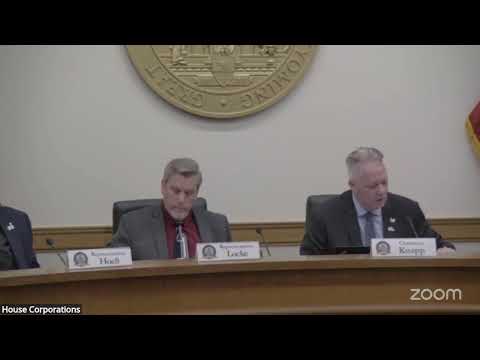
Committee advances third‑party filers bill after lengthy debate over privacy, scope and implementation
Summary
The Corporations, Elections & Political Subdivisions Committee advanced Senate File 55 on a unanimous roll call after lengthy testimony about whether the requirement to register ‘‘third party filers’’ would protect against filing fraud or needlessly expose thousands of employees’ personal data to the Secretary of State’s records.
CHEYENNE — The House Corporations, Elections & Political Subdivisions Committee on a 9‑0 roll call advanced Senate File 55, a bill that would require ‘‘third party filers’’ who file 10 or more documents with the Secretary of State in a calendar year to register with the office and provide notarized, sworn identification and contact information.
The legislation passed the committee by roll call vote after extended committee discussion and public testimony from the Secretary of State, business groups, commercial registered agents and trade organizations. The committee vote recorded 9 ayes and no nos; two members submitted absentee aye votes.
Secretary of State Chuck Ray and Colin Crossman, director of the Secretary’s business division, framed the bill as a targeted response to perceived filing‑fraud risks. Ray told the committee the policy “was really to ensure that serial third party filers ... are verified as real people.” The draft defines a third party filer as a natural person who receives compensation to file documents on behalf of a business entity and is not a direct employee, shareholder, director or otherwise under the entity’s direct management or supervision.
Under the engrossed language presented to the committee, a third party filer who files 10 or more documents in a calendar year would be required to register; further filings from that filer would be rejected until registration is complete. The registration application must be notarized and sworn under penalty of perjury and include the filer’s legal name, home and business addresses, phone numbers and email addresses (if applicable) and a copy of a state‑issued driver’s license or ID. The Secretary’s office may impose a civil penalty of up to $500 for each violation, and the bill directs the office to keep the registrant records confidential.
The draft includes a rule‑making provision and an appropriation. Crossman and Ray said implementing the requirement would require changes to the Secretary’s business software (WyoSuite) to capture and track filers and to flag when a filer reaches the 10‑document threshold. The bill carries a $150,000 appropriation in the engrossed text to fund system changes; officials said the estimate rose from an earlier $100,000 figure after more detailed scoping with the tech team.
Industry groups and commercial registered agents urged narrowing the bill. Kelly Manchester, president of Corp 1 and representing the National Public Records Research Association (NPRRA), said the draft is “very broad” and would require thousands of employees of registered‑agent firms to provide personal information that she argued is unnecessary to address the Secretary’s stated fraud concerns. Manchester and other witnesses recommended carving out registered agents or adopting an identifier system like FinCEN IDs to avoid transmitting employees’ home addresses and other PII to the Secretary of State.
Scott Meyer, an attorney who also identified himself as a commercial registered agent, and representatives of the Wyoming Society of CPAs said the carve‑outs for attorneys and certified public accountants that appear in the current draft make sense to them; Secretary Ray said he opposed an exemption for attorneys and CPAs and would prefer the requirement be applied across the board.
Several witnesses asked lawmakers to clarify whether the statute targets only people who sign and execute filings or whether it also applies to preparers who never sign documents. Secretary Ray and Crossman said the bill targets the person executing (signing) a document for filing and does not intend to capture delivery services or people who only prepare documents that clients ultimately sign.
After public testimony, Representative Brown moved the bill and Representative Weber seconded; the committee voted 9‑0 to pass Senate File 55 to the next stage. Members noted interest in working with the Secretary’s office to refine statutory language and implementation before final passage.
Legal and administrative details: the engrossed draft sets a $50 fee cap for registration costs (fee to be set by rule but not exceeding $50), provides confidentiality protections for registrant records, authorizes rulemaking, allows the Secretary to reject documents filed in violation of the registration requirement for up to 90 days after discovery, and sets an effective date of Jan. 1, 2026 for most sections with immediate effect for appropriations and rulemaking sections.
The committee directed the Secretary’s office to work with stakeholders over the interim on statutory clarifications and implementation planning.
Vote: Passed by roll call, 9 ayes, 0 nos; Representative Webb and Representative Yin recorded absentee ayes.