Get email alerts on the Iowa Property Tax System topic
No spam. Unsubscribe anytime.
LSA outlines Iowa property tax system and recent legislative changes
Summary
Michael Peters of the Legislative Services Agency summarized how Iowa determines assessed and taxable values, the rollback (assessment-limitation) system, exemptions and credits, tax increment financing, school funding links, and the effects of recent laws including House File 718 and Senate File 2442.
Michael Peters of the Legislative Services Agency summarized Iowa’s property tax system and recent legislative changes in an LSA presentation that reviewed how properties are assessed, how taxable values are calculated, and how recent laws alter levy limits and exemptions.
Peters said the presentation was intended as a high-level educational overview and walked through the full property-tax process from local assessment through bill issuance, with examples focused on residential property. “These are meant for educational purposes only and are not meant as LSA recommendations,” he told attendees.
The presentation explained three core concepts: property classes, the difference between assessed value and taxable value, and the two-year lag between assessment year and the fiscal year when taxes are due. Peters noted Iowa groups properties into nine classes, including residential, agricultural land, commercial, industrial and utilities, and said assessed value reflects market value while taxable value is the result after rollbacks and exemptions.
Peters outlined the typical property tax timeline: local and county assessors set assessed values; taxpayers may protest to local boards of review; the Iowa Department of Revenue performs equalization to ensure statewide consistency; assessment limitation (commonly called the rollback) adjusts taxable values; local governments set levy rates; and tax bills are issued. He emphasized assessors typically set values every two years (annually for utilities) and identified three valuing authorities depending on classification: county assessors, seven cities that self-assess (Ames, Cedar Rapids, Davenport, Dubuque, Iowa City, Mason City and Sioux City), and the Iowa Department of Revenue for utilities and railroads.
Agricultural property is assessed by a productivity formula, Peters said: a five-year rolling average of crop prices per acre minus expenses produces a productivity value that is multiplied by taxable acres. Agricultural buildings use a separate ‘‘ag factor’’ that reflects local conditions and production capacity.
Peters described equalization work done by the Iowa Department of Revenue in odd-numbered years via an assessment ratio study. He cited historical adjustment rates: 3.1% of jurisdictions were adjusted in 2019, about 6.4% in 2021, and about 7.2% in 2023. He noted the Department of Revenue releases an equalization report each September to guide adjustments.
On rollbacks (assessment limitation), Peters said residential and agricultural classes have a statutory cap that limits annual taxable-value growth to 3%, while utilities historically faced higher limits (8%). He explained the ‘‘agricultural tie’’ that constrains residential growth relative to agricultural growth: if agricultural taxable value decreases, residential growth can be limited or set to zero.
The presentation reviewed the historical arc of rollbacks: initial rollbacks in 1978 limited growth to 6% for residential and agricultural classes; later adjustments moved many classes to a 4% limit from 1980 to 2012 and to 3% for residential and agricultural beginning in 2013. Peters also noted a separate multi-residential class created in 2013 and later merged back into residential with an amended rollback in 2022.
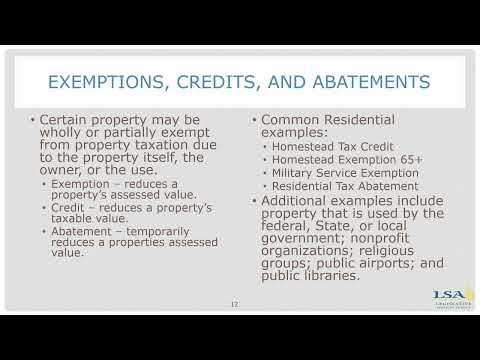
Peters summarized exemptions, credits and abatements that reduce taxes. He gave figures for the homestead programs: the homestead tax credit reduces taxable value by $4,850 (reimbursed to local governments from the state general fund), and a separate homestead exemption for persons 65 and older exempts $3,250 of taxable value for fiscal 2025 and increases to $6,500 in fiscal 2026 (this exemption is not state-reimbursed). He said the military service exemption was expanded to $4,000 in taxable value beginning in fiscal 2025 and is not reimbursed by the state.
On school funding, Peters explained that all properties are subject to a uniform levy of $5.40 per $1,000 of taxable value that feeds K-12 funding and that state foundation aid backfills districts up to an 88.4% foundation level based on the state cost per pupil. Peters gave the FY 2025 state cost per pupil as $7,826, a $191 increase from FY 2024.
Peters reviewed tax increment financing (TIF), noting cities or counties may create TIF districts by declaring areas slum, blighted or in need of economic development; increment (growth over a frozen base) can be used to pay debt for improvements. He said jurisdictions that participate must file a report with the Iowa Department of Management by Dec. 1 and that the Legislative Services Agency publishes an annual TIF report on Feb. 15. He also noted that creation of additional TIFs affects state backfill obligations and interacts with property tax replacement claim phase-out after fiscal 2029.
On recent legislation, Peters identified House File 718 (the Property Tax Assessments and Bond Elections Act, 2023 session) as consolidating 19 city levies into a consolidated general fund levy (CGFL), creating a tiered levy-growth limitation for cities, expanding homestead and military exemptions, and adding new taxpayer reporting requirements. He said Senate File 2442 (Individual Income Tax Rate Act, 2024 session) adjusted HF 718’s growth tiers—moving from three tiers to four for non-TIF taxable value—and updated annual taxpayer statements, publication rules and budget certification deadlines. Peters also said counties may collect but not distribute funds until their budgets are certified and that a new assessment limitation for pipeline utility property will phase that class to 90% of value by assessment year 2029 (a roughly 2% annual decrease beginning in assessment year 2025).
Peters closed by directing listeners to the LSA Fiscal Services Division website for detailed reports and legislative documents. He repeatedly framed the presentation as informational and provided sample calculations to illustrate how exemptions, credits and rollbacks affect a hypothetical $200,000 residential assessment.
Ending note: The presentation included numerical examples, statutory references and a depiction of how recent law changes shift levy structures and reimbursement responsibilities; Peters urged viewers to consult the Fiscal Services Division resources for full data and implementation details.
AI generated
The text on this page is AI generated. Summaries, highlights, analysis, and video transcripts are all produced from the original source material.
AI can make mistakes, so if you spot one, and we will fix it for everyone.
Note: the source content is unaltered by us. Any content source we link to, be it a video, an audio recording, or a document, is presented exactly as its publisher released it. That publisher is usually a government body, sometimes an individual official or another organisation.