Get Full Government Meeting Transcripts, Videos, & Alerts Forever!
Get email alerts on the State Tax Revenue topic
No spam. Unsubscribe anytime.
LSA: Iowa tax revenue stabilized after pandemic surge; REC projects lower FY25 receipts
Summary
At an LSA presentation, Eric Richardson of the Legislative Services Agency described recent trends in Iowa tax revenue, noted the introduction of the pass-through entity tax, and summarized Revenue Estimating Conference projections that put FY25 net receipts down from FY24.
Eric Richardson, senior fiscal analyst for the Legislative Services Agency, told an LSA “Dollars and Donuts” presentation that Iowa’s statewide tax collections surged during 2021–22 because of federal transfer payments, then stabilized in 2023–24 as tax cuts took effect.
Richardson said the total of state and local net tax revenue for fiscal year 2024 was $19,300,000,000, with 35.5% from local property taxes, 20.8% from sales and use taxes and 19.4% from individual income tax. He also summarized the Revenue Estimating Conference (REC) projections reached on Dec. 12, 2024: “The REC met on 12/12/2024 and agreed to a estimated FY '25 net receipts plus transfers total of $9,154,000,000,” Richardson said, and the REC’s estimate for FY26 net receipts plus transfers was $8,726,000,000.
The presentation distinguished the larger state-and-local revenue total and the REC’s net‑receipts figure, which cover different measures. Richardson noted that FY24 growth slowed compared with 2021–22: “FY 2024 had the lowest tax revenue growth since FY 2014.” He attributed the earlier large increases to federal transfer payments that filtered through the economy and said tax cuts beginning in 2023 reduced net state taxes in 2023–24 while local option and property taxes offset some of that decline.
Richardson described changes in revenue composition driven by a newly introduced pass-through entity tax (PTET). He said other taxes rose in FY24 primarily because PTET revenue came in retroactive to tax year 2022. “Other taxes have gone up from 3.3% to 6.5%, primarily due to the pass through entity tax being introduced over the last year,” he said. Richardson added that the PTET’s retroactive treatment and subsequent tax-credit reallocations contributed to volatility in “other” tax receipts and to slower PTET-related collections in FY25 once credits were claimed.
On specific revenue items, Richardson reported that interest paid into the general fund was about $70 million in FY2023 and $130 million in FY2024, and he noted a corporate income tax rate reduction to 7.1% as of tax year 2024. He also reviewed tax-credit claim history, saying claims rose through FY2020, dropped after recent legislation, then increased in FY2024 mainly because of the research activities, historic preservation and high-quality jobs tax credits.
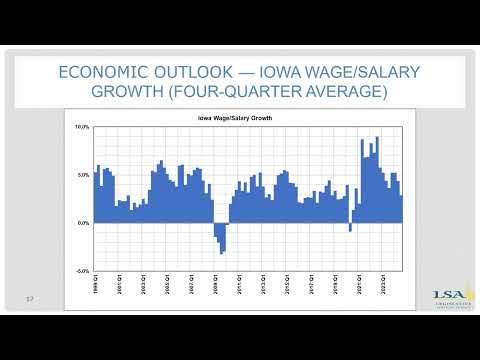
Turning to broader economic context, Richardson cited demographic and labor trends that affect the tax base. He said Iowa’s population grew 0.72% in 2024 — the state’s highest rate this century — and that Iowa reached an employment peak of about 1,600,000 jobs in June 2024 but has seen some recent declines tied to layoffs in finance and manufacturing. He summarized other national measures — from wage growth to CPI and federal interest rates — to explain how inflation, borrowing costs and consumer spending influence state revenue collection.
Richardson highlighted that the REC will meet again in March 2025 to update its estimates. He closed by pointing listeners to LSA’s fiscal publications and contact information: “You can find our fiscal division website and the publications that we produce at the link,” he said.
The presentation was a briefing and did not include any formal actions or votes.