Get Full Government Meeting Transcripts, Videos, & Alerts Forever!
Get email alerts on the Local Sales Tax Authority topic
No spam. Unsubscribe anytime.
Committee adopts amendment and lays over bill giving cities authority to seek voter-approved local sales taxes
Summary
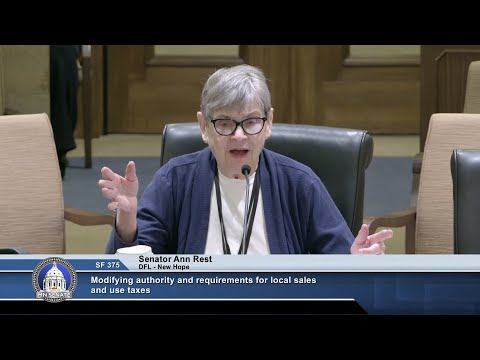
Senate File 375, introduced by Senator Rest and discussed Feb. 26 in the Minnesota Senate Taxes Committee, would create a general authority allowing cities to propose voter-approved local sales taxes to fund projects of regional significance.
Senate File 375, introduced by Senator Rest and discussed Feb. 26 in the Minnesota Senate Taxes Committee, would create a general authority allowing cities to propose voter-approved local sales taxes to fund projects of regional significance.
The bill enumerates qualifying project categories, sets a cap on new local sales taxes at a half-cent in most cases, creates a process for Department of Revenue review of eligibility, and includes an inflation adjustment for project revenues. The A5 author’s amendment was offered in committee, an oral revision deleting lines 1.2 to 3.3 was adopted, and the committee laid the bill over for possible inclusion.
Equalization and sharing pools. A major element in the discussion was an "equalization" mechanism that would withhold 5% (or 8% if the tax is imposed by special law) of a contributor city's local sales tax revenues and distribute those amounts to a pool of qualified recipient cities. Department of Revenue staffer Rachel Johnson walked the committee through multiple color-coded examples to illustrate how contributors and qualified recipients would be identified and how sharing pools would be allocated differently in metro and nonmetro counties.
Johnson said a "contributor" is a city that imposes a local sales tax under section 297.9901 or by special law, and a "qualified recipient" must not itself be a contributor, must not have imposed a local sales tax in the prior calendar year, and must be contiguous to a contributor in metro counties or located partly in a nonmetro county that contains a contributor. The A5 amendment, as presented, limits equalization to cities (excluding counties) so that only cities would participate in sharing pools.
Prevailing wage debate. The bill initially included a prevailing-wage requirement for projects paid with these local sales tax revenues. That language had applied only to metro-area projects and drew objections from labor groups and some senators because it would have treated metro and Greater Minnesota workers differently. The A5 amendment removed the prevailing-wage language; witnesses from the Minnesota Building and Construction Trades Council urged the committee to restore prevailing-wage protections in later drafts, citing Minnesota statutes and the Department of Labor and Industry’s county-by-craft surveys as the mechanism for setting rates.
Stakeholder testimony. City and county officials, regional associations and construction labor representatives testified in support or raised concerns:
- Jenny Maxx, city administrator of Nisswa and League of Minnesota Cities representative, told the committee the bill would give cities a clearer, more transparent process to plan projects without repeated special-legislation requests.
- Michael Williams (representing association stakeholders including AMC and MICA and noting Stearns County’s recent successful referendum for a justice center) said counties provide regionally shared services and supported allowing counties to use local sales taxes for large, costly public-safety projects.
- Patricia Nauman, executive director of Metro Cities, said Metro Cities supports the bill’s diversification of local revenue options and found the equalization examples helpful, though Metro Cities had no formal position on the equalization formula as presented.
- Kyle Macarios of the Minnesota Building and Construction Trades Council opposed the selective prevailing-wage approach that had been in earlier drafts and urged inclusion of prevailing-wage protections to ensure taxpayer-funded projects pay locally prevailing rates.
- Bradley Peterson of the Coalition of Greater Minnesota Cities praised the bill’s list of eligible projects and urged considering additional categories such as housing; he also noted members’ concerns about the equalization withholding, which can complicate project budgeting.
Other technical provisions. Sen. Rest described process elements intended to reduce the need for special legislation: a Department of Revenue review of statutory guidelines, definitions for local sales taxes, and limits to how frequently local governments can seek new taxes if already at the statutory cap. She also said the bill leaves the current moratorium in statute and that the moratorium expires June 1; that timing and other technical matters shaped several of the amendment choices.
Committee action. The A5 author’s amendment was offered, orally amended to delete specified lines, adopted in committee, and Senate File 375 as amended was laid over for possible inclusion.
Ending: Sponsors and stakeholders agreed to continue technical discussions and an informal follow-up review once an unofficial engrossment is available. The committee will revisit the bill in future proceedings.