Get Full Government Meeting Transcripts, Videos, & Alerts Forever!
Get email alerts on the Home Care Reimbursement topic
No spam. Unsubscribe anytime.
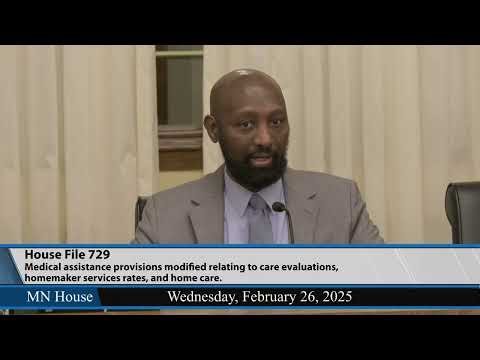
Committee hears bill to raise home-care reimbursement, fund nursing preceptor grants; bill laid over
Summary
The House Human Services Finance Policy Committee reviewed House File 7‑29, which would reimburse mandated home‑care evaluation visits, increase some home‑care Medical Assistance rates and create a one‑time grant program to compensate nurse preceptors; the bill was laid over for possible inclusion.
The House Human Services Finance Policy Committee reviewed Representative Knorr's House File 7‑29, a three‑part proposal to change how Minnesota pays for certain home‑care services, and laid the bill over for possible inclusion.
The bill, as described by testifiers, would (1) establish a separate reimbursement for a limited annual number of comprehensive home‑care evaluation visits, (2) adjust Medical Assistance reimbursement rates for a defined set of home‑care services, and (3) create a one‑time grant program focused on recruiting home‑care staff by compensating nurses who serve as preceptors for nursing students.
Kathy Messerly, executive director of the Minnesota Home Care Association, told the committee MHCA members provide “hands on care to more than 30,000 older Minnesotans and individuals with disabilities in their homes,” and argued that hospitals and long‑term care settings are not preferred for most people. Messerly said sections 1–7 would reimburse required, more‑time‑consuming evaluation visits — including start‑up, 60‑day recertification and resumption‑of‑care visits — that currently take three to five times as long as a routine visit but are paid at the same rate. “Expecting providers to cover the cost of the mandated evaluation visits adds to the challenge of meeting the needs of people in the community,” Messerly said.
Jen Baker, administrator with Good Samaritan Society Home Healthcare in Robbinsdale, described the time burden on agencies and said some agencies are turning away Medical Assistance patients because reimbursement and staffing limits make the care financially infeasible. “These in‑depth care evaluations…can take up to 2 hours in the home alone plus an additional 2 to 3 hours of documentation,” Baker said, adding that agencies currently absorb those costs. Baker also described a recent case in which home‑care intervention avoided a hospital readmission for a 94‑year‑old patient.
On rates, Messerly asked for “rates a bit closer to the cost of providing care” to help providers address recruitment and retention through improved wages and benefits. Messerly described the bill's Section 8 as adjusting Medical Assistance rates for homemaker services under the disability and elderly waivers, home health agency services (including home health aides, rehab therapy and skilled nursing) and home‑care nursing services.
Section 9, as amended, narrows the grant program to compensation for home‑care nurses who agree to serve as preceptors for nursing students; witnesses said the goal is to expand clinical rotation opportunities and expose more nurses to home care as a career path.
Committee nonpartisan fiscal staff, represented by Mr. Burke, told members there was a fiscal note on similar provisions in 2024 estimating costs of about $2.3 million in 2025, $5.4 million in 2026 and $5.0 million ongoing, and that the current bill includes additional items (a rate increase and a grant appropriation) that require more information before they can be scored.
Members asked how success would be measured; witnesses suggested reduced numbers of Medical Assistance clients being turned away would be a primary metric and said anecdotal reports from colleges indicate demand for clinical rotations but that the number of nursing students entering home care is not well tracked. Committee members also asked about Greater Minnesota access; Representative Knorr said the bill's amendment (section 9, subdivision 4) calls for geographically distributed grant awards based on enrollment and service availability.
The committee closed public testimony, thanked the witnesses and laid House File 7‑29 over for possible inclusion. No formal floor vote on adoption of the bill occurred in committee.
Votes at a glance: Representative Knorr moved that House File 7‑29 be laid over for possible inclusion; the motion was accepted and the bill was laid over (voice action; no roll‑call tally recorded).