Get Full Government Meeting Transcripts, Videos, & Alerts Forever!
Get email alerts on the Medicaid Rates Health Plan Assessment topic
No spam. Unsubscribe anytime.
Senate panel advances bill to raise Medicaid rates for mental health, funds changes via health-plan assessment
Summary
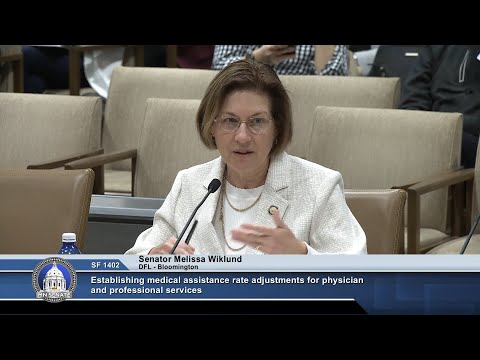
The Minnesota Senate Health and Human Services Committee voted to recommend passage of Senate File 1402, a bill to increase Medicaid reimbursement rates for mental health and other services and to fund those increases primarily through a new health-plan assessment designed to leverage federal matching dollars.
Senator Wiklendt brought Senate File 1402 before the Minnesota Senate Health and Human Services Committee and, after adopting an amendment that adds a financing mechanism, the committee voted to recommend the bill to the taxes committee.
The bill would increase reimbursement rates for Medical Assistance (MA, Minnesota’s Medicaid program) providers, implement recommendations from the Department of Human Services’ outpatient rate study and raise rates for community-based children’s and adult mental health services. As amended, the bill funds those changes using a health-plan assessment intended to draw down federal matching funds and return most of the assessment to managed care organizations through higher capitation payments.
The measure’s sponsor said implementation would occur over three years and that the assessment is structured with tiers and caps to limit the impact on smaller plans. “This amendment…adds a fiscally responsible and innovative funding solution that relies on a health plan assessment,” Senator Wiklendt said when moving the author’s amendment.
Clinicians and provider groups urged action. Dr. Katie Semenek, a general pediatrician testifying on behalf of the Minnesota Medical Association and the Minnesota Chapter of the American Academy of Pediatrics, said current MA rates are far below costs and that raising rates would improve access and help clinics remain open. “When rates can’t keep up, services are cut, communities are left without care, and patients like mine suffer,” she said. Jessica Brissboys, manager of acute mental health services at Children’s Minnesota, described dramatic increases in children boarding in hospitals and said about 70 percent of patients boarding at her hospital rely on Medicaid. “Across all of our mental health services, we are reimbursed for less than half of all of our costs,” she testified.
Providers and advocates said higher rates are necessary to retain staff and maintain outpatient capacity, while representatives of the Minnesota Council of Health Plans and the Chamber of Commerce raised concerns the assessment would increase premiums for fully insured commercial members. Dan Andreesen of the Minnesota Council of Health Plans said nonprofit insurers would bear most of the assessment and warned of premium impacts. “Under the current design, a portion of this assessment does fall on the commercial insurance market and we’re concerned about the impacts of this in terms of higher premiums,” he said.
Supporters pointed to other states that used similar financing mechanisms. Dave Renner of the Minnesota Medical Association said the bill’s design follows approaches in other states such as California and West Virginia and that, under the bill, payers would receive roughly 99% of the assessment back through higher capitation rates when federal matching funds are claimed. Committee members pressed DHS and bill proponents on implementation details and federal risk. DHS staff explained the bill builds on existing payment methodologies and said services already paid under the Resource-Based Relative Value System would continue under the change.
Committee members debated federal approval risk and downstream effects on premiums and state budgets. Some members urged caution about creating ongoing base funding dependent on federal matching; others said the approach offers a practical way to raise rates in a tight budget environment. Senator Wiklendt said the bill was an attempt to “find a way forward in a difficult year for us, budget wise,” and committed to continued conversations with stakeholders to refine the amendment language.
The committee adopted the author’s A1 amendment by voice vote and later approved the bill, as amended, on a roll call (five yes, four no) and recommended it be referred to the taxes committee. The official roll-call list in the record was incomplete; the committee clerk recorded the tally as 5–4 in favor.
If enacted, the bill would phase in rate changes over three years and use the proposed assessment to generate state dollars that can be matched with federal Medicaid funds; proponents estimate implementing the full rate proposal would cost more than $300 million over a biennium, and the MCO assessment in the proposal was described in committee discussion as producing roughly $748 million in state-level funds in the design presented to the committee. Committee members asked DHS to produce a detailed fiscal note before further action.
Votes at a glance: Senate File 1402 (as amended) — Committee recommendation to pass and refer to taxes; roll-call recorded 5 yes, 4 no.
Ending: The committee’s action advances a high-profile effort to increase MA rates for children’s and other mental health services while also prompting further negotiations over funding design and premium effects; the bill will next be considered by the taxes committee and DHS will prepare fiscal estimates for the legislature.