Get Full Government Meeting Transcripts, Videos, & Alerts Forever!
Get email alerts on the Emergency Powers topic
No spam. Unsubscribe anytime.
Committee adopts amendment preserving governor's military authority; House File 26 laid over
Summary
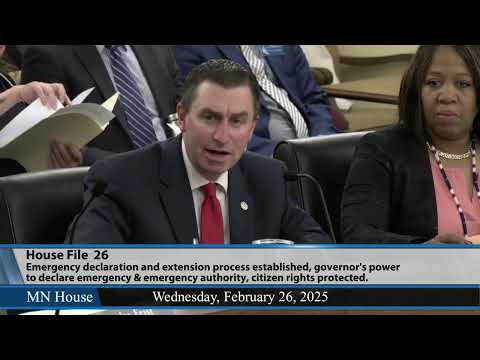
House File 26, titled the "Never Again Act," was discussed in the Minnesota House Veterans and Military Affairs Division on a narrow remit: provisions affecting the governor's authority to call up the Minnesota National Guard during emergencies. The committee adopted amendment A4, which states that nothing in the bill limits the governor's constitutional authority over military forces, and then laid the bill over for further consideration.
House File 26, titled the "Never Again Act," was discussed in the Minnesota House Veterans and Military Affairs Division on a narrow remit: provisions affecting the governor's authority to call up the Minnesota National Guard during emergencies. The committee adopted amendment A4, which states that nothing in the bill limits the governor's constitutional authority over military forces, and then laid the bill over for further consideration.
The bill's author, Representative Roach, told the panel the measure responds to what she called 'overreach and abuses' during the COVID-19 pandemic and that the bill 'removes the governor's unilateral ability to declare an emergency,' clarifies that executive orders are not law and would create criminal penalties for certain violations. 'The Never Again Act is a response to the overreach and abuses of a runaway governor,' Representative Roach said.
Agency witnesses raised operational concerns about the bill as introduced. Don Kerr, executive director of the Minnesota Department of Military Affairs, said the bill 'would really have no effect on the governor's authority over the National Guard because that authority is embedded in the constitution and also in federal law,' but warned that restricting the governor's early emergency tools could force use of the Guard in situations better handled by other state agencies. Kerr cited the 2012 Duluth flood as an example in which the Department of Transportation's heavy equipment, not National Guard assets, was the most appropriate local response.
John Kelly, director of government affairs for the Minnesota Department of Veterans Affairs, told the committee House File 26 'would be more problematic with respect to our disaster relief grants.' He said Administrative Rule 90 55 currently activates State Soldiers Disaster Grants only when there is a declared emergency and that the bill's repeal of chapter 12.31 in part could remove the rule's trigger. Kelly said that if the statutory trigger were repealed the agencies would likely need to complete administrative rulemaking to restore or revise the trigger, a process that would delay distribution of relief funds.
In response to those concerns, Representative Roach and members discussed clarifying language. The chair introduced amendment A4, described in committee materials as 'nothing in this bill limits the governor's constitutional authority over the military.' Agency witnesses expressed appreciation for the clarifying language. Kerr said the amendment was helpful even if, in his view, the constitution already controls statutory attempts to limit the commander-in-chief role.
The committee adopted amendment A4 by voice vote and, because the bill had been referred directly from the State Government Finance Committee under House Rule 6.05, the chair stated he would lay over House File 26.
Key outstanding issues the committee identified include whether repeal language in the bill would require administrative rulemaking to preserve or restore activation triggers for State Soldiers Disaster Grants under Administrative Rule 90 55 and the practical effect of narrowing the governor's emergency-declaration powers on the timing of disaster response and relief distribution.
Votes at a glance Amendment A4 (clarifies nothing in the bill limits governor's constitutional authority over the military): adopted (voice vote). Disposition of House File 26: laid over to a future meeting.
Next steps The bill remains pending. Agency staff indicated they are willing to work with the bill author to address the administrative-rule and disaster-grant concerns if the measure advances.