Get Full Government Meeting Transcripts, Videos, & Alerts Forever!
Get email alerts on the Worker Misclassification topic
No spam. Unsubscribe anytime.
State agencies report early progress on enforcement partnership to address worker misclassification
Summary
At a committee hearing, the Intergovernmental Misclassification Enforcement and Education Partnership described its first six months of work, including data‑sharing efforts, cross‑training, targeted outreach and a DLI budget request for additional enforcement staff.
The Workforce, Labor and Economic Development Finance and Policy Committee heard a progress report on a multiagency partnership formed to detect and address worker misclassification in Minnesota.
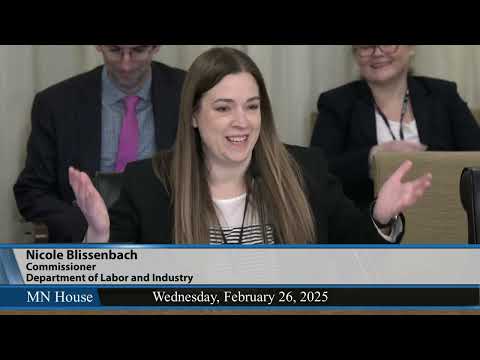
Nicole Blissenbach, commissioner of the Minnesota Department of Labor and Industry, told the committee the Intergovernmental Misclassification Enforcement and Education Partnership — formed in the prior legislative session — has met repeatedly since it began work July 1, 2024, and set up four work groups focused on enforcement, education and outreach, data sharing, and reporting and analytics.
The partnership, Blissenbach said, brings together the Department of Commerce, Department of Revenue, Department of Labor and Industry (DLI), Department of Employment and Economic Development (DEED) and the Attorney General's Office to coordinate investigations, share data, pursue joint investigations and provide unified outreach for employers and workers.
Committee members were shown national and regional studies cited by the partnership to illustrate the scale of the problem. Blissenbach summarized findings presented to the panel: published estimates indicate misclassification is common in several industries and imposes economic costs on workers and state social insurance programs. The partnership drew from a 2023 Economic Policy Institute report, a 2019 North Star Policy Action analysis for Minnesota, a 2021 Midwest Economic Policy Institute study focused on construction, and the Office of the Legislative Auditor's 2024 review of misclassification.
Officials from partner agencies described current practices and changes since the 2024 law enacted the partnership and strengthened enforcement tools. DEED said it has enlarged its unemployment insurance audit staff and is conducting more audits (nearly 1,400 completed in the most recent year) and employer outreach that includes misclassification guidance. The Department of Revenue reported it has audited hundreds of businesses for withholding and classification issues and found classification problems in a majority of those audits. The Attorney General's Wage Theft Division said misclassification accounted for roughly 22% of wage‑theft‑related complaints in 2024 and that misclassification investigations can absorb substantial staff time, particularly where litigation or large, multiworker cases are involved.
Blissenbach described DLI's internal changes after the law took effect: DLI has a team focused on misclassification intakes, cross‑trained with its outreach staff, and has increased use of expedited remedies such as wage claims and informal "inform and educate" letters to resolve violations quickly. She said DLI has seen a marked increase in misclassification intakes since mid‑2024 and that the department is prioritizing efficient resolutions when records are available. Blissenbach also highlighted two case examples: a food‑service employer who reclassified workers to avoid paid‑leave obligations and corrected classification after an informal notice; and a transportation employer that cooperated with an investigation and reclassified two drivers as employees.
The partnership's data sharing work group is drafting agreements so agencies can exchange information while complying with federal and state privacy law, Blissenbach said. The enforcement work group meets biweekly to deconflict investigations and plan strategic enforcement in industries with elevated misclassification risk. The partnership's reporting and analytics work group is developing metrics to measure effectiveness over time.
Commissioner Blissenbach noted the partnership's statutory report due March 1, 2025, and said the group intends to continue quarterly meetings; she also pointed to a DLI budget recommendation on the governor's proposal: funding for an additional 2.5 FTE positions to support enforcement of misclassification laws.
Why it matters: Misclassification can deny workers minimum wage, overtime, benefits and social insurance coverage, and reduces state tax and premium collections. Committee members pressed agencies on data‑sharing timelines, the mix of industries affected and next steps for strategic enforcement. Several lawmakers praised the partnership model and urged faster completion of data agreements with the Department of Revenue so partners can better coordinate audits and referrals.
Ending: Blissenbach and agency witnesses said the partnership is still early in its work and expected to have additional, more detailed findings as interagency data sharing and coordinated investigations progress. The committee is scheduled to revisit the subject in subsequent hearings.