Get Full Government Meeting Transcripts, Videos, & Alerts Forever!
Get email alerts on the Local Government topic
No spam. Unsubscribe anytime.
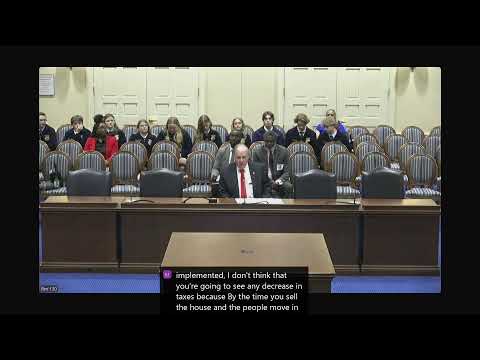
Ways and Means Committee holds hearings on a slate of local tax, election and property bills
Summary
The House Ways and Means Committee on Feb. 26 heard testimony on a series of bills affecting property taxes, election registration, tax‑sale notices and local taxing authority in Maryland.
Annapolis — The House Ways and Means Committee on Feb. 26 held hearings on a package of local and statewide bills addressing property-tax treatment, election registration, tax-sale notices and municipal taxing authority.
Committee Chair Atterberry opened the session and called presentations on a series of bills; presenters finished with a request for favorable reports but no committee votes were recorded during the hearing.
House Bill 13-43 — Anne Arundel County property tax credit for large licensed childcare homes Josh, presenting on behalf of Delegate Dana Jones, told the committee the bill would expand Anne Arundel County's authority to grant property tax credits “to owners of licensed large childcare homes.” He said Maryland faces “a childcare crisis” and that HB 13-43 would give the county another tool to reduce provider costs in neighborhoods with limited access to care, including Annapolis, Glen Burnie, Severn, Brooklyn Park and South County. The presentation included favorable testimony from the county executive's office and delegation support. The hearing concluded with no committee vote recorded.
House Bill 12-80 — Allow unaffiliated voters to affiliate during early voting Delegate Lily Chee told the committee HB 12-80 would allow unaffiliated registered voters to affiliate with a party at the time they register in person during early voting, so they may participate in closed primaries without meeting the current three-week deadline. Chee said unaffiliated voters now number about 900,000 in Maryland and argued the change would make primaries more inclusive. Committee members questioned administrative details and how the bill would interact with same‑day registration; an elections official on the panel clarified that someone using same‑day registration can choose party affiliation, but the bill would change the process for already registered unaffiliated voters. The hearing concluded with no committee vote recorded.
House Bill 13-32 — Glenstone Foundation property tax exemption for conservation land Delegate Lily Chee presented HB 13-32 seeking to exempt portions of the Glenstone Foundation’s Potomac campus that are used exclusively for environmental conservation from property tax. Chee said Glenstone manages roughly 300 acres, has planted “over 13,000 native trees,” undertaken large stream‑restoration projects and stores “nearly 1,000,000 gallons” of rainwater on site. She and a resource person, Martin Lutz, said several parcels have been classified as vacant in tax assessments despite active conservation management; testimony cited precedent for exemptions granted to other conservation organizations. The fiscal impact was described as small — cited in testimony as roughly $76,000 for a single county — and the hearing concluded with no committee vote recorded.
House Bill 11-60 — Calvert County personal property tax exemption contingent on PILOT with data center Delegate Mark Fisher presented HB 11-60, which would exempt most business personal property in Calvert County from taxation, effective June 1, 2025, contingent on the county entering a payment‑in‑lieu‑of‑taxes (PILOT) agreement with a data center. Fisher said the bill excludes certain property types (railroad, public utility property, fiber and cable systems, cell towers, electronic instant-bingo machines and property already subject to a PILOT). He described the measure as conditional on a large pilot agreement that would offset the revenue loss for the county. The hearing concluded with no committee vote recorded.
House Bill 12-78 — Require internet vacation-rental platforms to collect Garrett County accommodations tax Delegate Jim Heinbaugh presented HB 12-78, a local bill allowing Garrett County to require internet vacation‑rental platforms (examples named in testimony included VRBO and Airbnb) to collect the county’s 8% accommodations tax on short-term rentals. Heinbaugh said the accommodations tax is expected to generate about $6 million this year for the county’s restricted tourism and economic development fund and that requiring platform collection would level the playing field with local rental companies that already collect the tax. Committee members discussed administrative fees and whether a statewide approach would be preferable; the hearing concluded with no committee vote recorded.
House Bill 13-72 — Washington County notice and publication changes for tax sales A local bill presented by Delegate Bridal would alter how Washington County advertises tax sales and require additional post‑sale notices. The proposal would require two newspaper publications in alternating weeks, weekly updates to the county website beginning four weeks before sale, and a second post‑sale notice to owners within 15 days of sale (currently only one post‑sale notice is sent). The county treasurer provided a letter of support, and presenters said the changes reflect local practice while responding to concerns about online‑only processes elsewhere. The hearing concluded with no committee vote recorded.
House Bill 13-33 — Washington County property tax credit eligibility for disabled veterans (technical clarification) Delegate Bridal presented HB 13-33, which she described as a clarifying change to existing Washington County authority to grant property‑tax credits to honorably discharged disabled veterans and surviving spouses. The bill replaces a reference to “active military, naval, or air service” with the Uniformed Services definition in the U.S. Code; presenters said it codifies current practice. The hearing concluded with no committee vote recorded.
House Bill 1,200 — Expand local property tax credit for public‑safety survivors to include judicial officers and correctional officers Delegate William Valentine presented HB 1,200, which would enable counties and Baltimore City to extend an existing property‑tax credit for law‑enforcement officers and rescue workers to include judicial officers, correctional officers and surviving spouses or cohabitants of judicial officers at local discretion. Valentine said the bill is enabling legislation and that the Senate had passed a cross‑file 502 the prior week. The hearing concluded with no committee vote recorded.
House Bills 11-78 and 11-89 — Baltimore City municipal taxing authority and taxing certain vacant nonprofit properties Delegate Kalyn Young presented two Baltimore City bills. HB 11-78 would allow Baltimore City to set special tax rates for municipal services in the way other municipalities do; Young said the city’s single flat rate creates mismatches between services received and taxes paid. HB 11-89 would give the city council authority to raise taxes on certain nonprofit‑owned, taxable properties that have been vacant or nonproductive for at least three years, with the option to increase those rates up to 10 times the current tax under locally adopted legislation. The hearing concluded with no committee vote recorded.
House Bill 12-14 (and related HB 14-10) — 3-year assessment relief for some first‑time homebuyers Delegate Bob Long presented HB 12-14 proposing to hold assessed value steady for three years for qualifying first‑time homebuyers who buy properties with long‑time owner assessments, to ease the tax burden that can follow a sale. Long described the measure as a temporary, three‑year “breathing period” to encourage market mobility. The hearing concluded with no committee vote recorded.
What happened next All presenters requested favorable reports or further consideration. Committee members asked procedural and implementation questions (for example about administrative fees and how a change would interact with same‑day registration or county collection mechanisms). The hearing concluded with presenters directed to follow up on specific administrative or fiscal clarifications; the committee did not take final votes at the Feb. 26 session.
(For auditors: presenters’ statements and the committee’s questions are recorded in the committee transcript; no committee roll‑call or recorded votes occurred during this hearing.)