Get Full Government Meeting Transcripts, Videos, & Alerts Forever!
Get email alerts on the Public Health topic
No spam. Unsubscribe anytime.
Lancaster to publish citywide health assessment; $200,000 set aside for initial actions
Summary
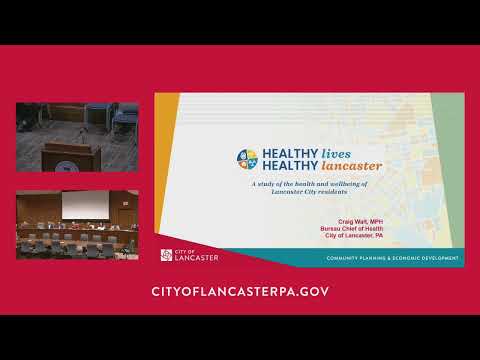
City health bureau told council Feb. 25 that the Healthy Lives, Healthy Lancaster assessment will be released in March or April, after surveying more than 1,100 residents; council previously set aside $200,000 from CDBG CARES Act funds for initial implementation.
Lancaster City officials said Feb. 25 they will release a citywide health and well-being assessment in March or April and have set aside $200,000 in Community Development Block Grant CARES Act funds to begin implementing priority actions.
The assessment, called Healthy Lives, Healthy Lancaster, was led by the City Bureau of Health with consultant Build Community and collected more than 1,100 resident surveys, over 1,000 resident interactions at outreach events, more than 100 focus-group participants, and interviews with more than 200 stakeholders and 20 key informants, Craig Walt, Bureau Chief of Health for the City of Lancaster, told council. "We wanted to put together a comprehensive Lancaster City community health profile," Walt said.
Why it matters: the report maps health outcomes and social vulnerability across the city and identifies priority areas that city staff and partners say will guide work on housing, food access, behavioral health, public-health preparedness and the built environment. City officials said the report will include specific strategies and recommended action steps, and an online dashboard is planned to make the data and tracking publicly available.
Details from the presentation: Walt said the study combined federal, state and local secondary data with primary data gathered through the survey and listening sessions. The presentation showed maps linking social vulnerability to lower life expectancy in parts of the city and highlighted childhood lead poisoning as an ongoing concern compared with county and state rates. The project team said it engaged 50 community organizations and monitored participation to ensure broad geographic and demographic representation.
Walt said the assessment groups priorities into tiers. Tier 1 priorities—most actionable at the city level—include safe, healthy and sustainable communities with emphasis on food systems, water, housing, recreational spaces and streets. Tier 2 areas include access to services, homelessness and community health, public-health emergency preparedness, and climate-responsive public health; city staff said those will require stronger community partnerships to implement.
Dr. Jessica Amie, a member of the Lancaster Board of Health and an advisory committee participant, said the study focused intentionally on neighborhood-level outreach. "This was the first health needs assessment of its kind to focus specifically on the needs of Lancaster City," she said, describing efforts such as plant-and-seed distribution days where staff conducted surveys and talked directly with residents.
Next steps: city staff said they expect to publish the summary report and supporting data in March or April, to launch the online dashboard in the following months, to reconvene the advisory committee to prioritize implementation, and to mobilize the previously allocated $200,000 for initial actions tied to the assessment. Walt told council some action items will require cross-departmental coordination and further conversations with community partners before being finalized.
The presentation did not request immediate legislative action; council members asked about ways to engage, and staff suggested coalition-building or work groups to pursue specific strategies. The report will be posted and staff indicated they will return with more detailed, department-level implementation proposals for council consideration.