Get Full Government Meeting Transcripts, Videos, & Alerts Forever!
Get email alerts on the Closed Session Actions topic
No spam. Unsubscribe anytime.
SFUSD board reports closed‑session actions: litigation authority and employee resignation agreement
Summary
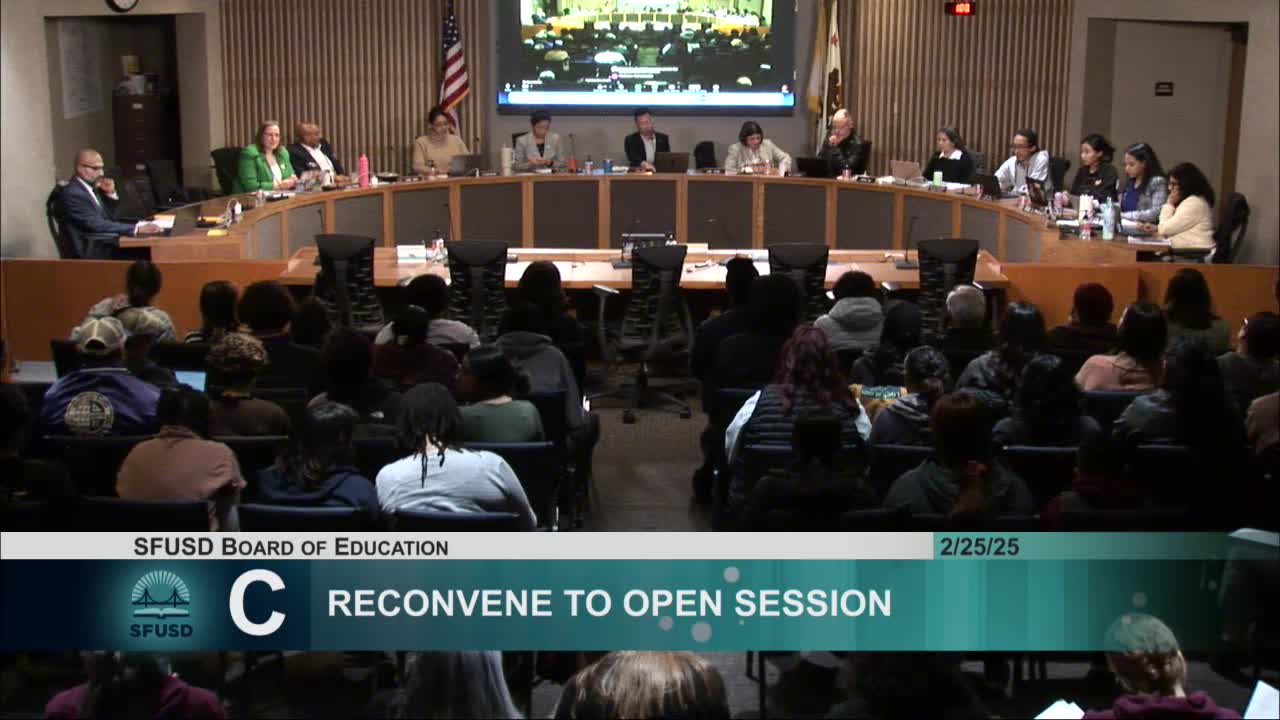
At the start of the public meeting the San Francisco Unified School District reported that, after a closed session on litigation and personnel matters, the board authorized the general counsel to pay up to a stipulated amount in a pending lawsuit and approved a resignation agreement for a permanent classified employee.
The San Francisco Unified School District board opened its public meeting by reporting actions taken in closed session, including direction to the district general counsel on a litigation settlement and approval of a personnel agreement.
President Kim said the board met in closed session on legal and personnel matters and that, "In one matter of anticipated litigation, the board, by a vote of 7 ayes, gives direction to the general counsel." The closed‑session readout identified the case as SN v. SFUSD, San Francisco Superior Court Case Number CGC‑22‑601980, and stated the board "gave the authority of the district to pay up to the stipulated amount." The board also approved a resignation agreement for a permanent classified employee and released temporary certificated employees and non‑elected certificated probationary employees by unanimous vote, according to the readout.
The board described the district's governance model and its emphasis on a student‑outcomes focus following community input, and then proceeded to its public agenda and a multi‑hour period of public comment on the budget.
Why this matters
Closed‑session actions that authorize settlement payments and finalize personnel agreements can have direct fiscal and operational implications for the district. The readout identified a specific Superior Court case and disclosed the board’s authorization to settle up to a stipulated amount, and it recorded personnel actions that affect employee status.
Speakers
President Kim (first reporting the closed session readout).