Get Full Government Meeting Transcripts, Videos, & Alerts Forever!
Get email alerts on the Housing Development topic
No spam. Unsubscribe anytime.
Supervisors approve waiver to spur downtown office-to-residential conversions with 7 million‑sq‑ft cap
Summary
The Board passed an ordinance on first reading to waive certain development impact fees for targeted downtown office‑to‑residential conversion projects, adding a 7,000,000‑square‑foot cap to limit total exemptions.
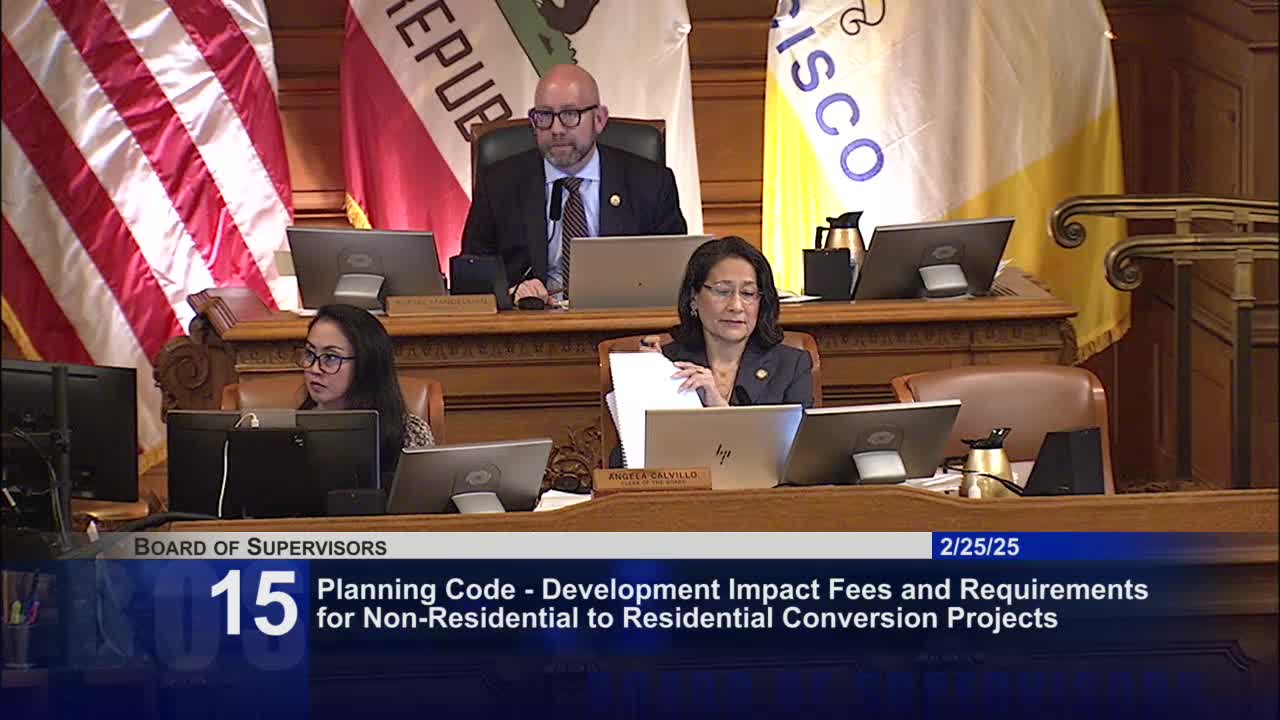
The San Francisco Board of Supervisors on Feb. 25 passed on first reading an ordinance to waive certain development impact fees for a targeted set of downtown office‑to‑residential conversion projects, with a 7,000,000‑square‑foot cap on the total square footage eligible for the waiver.
The measure, introduced by Supervisor Matt Dorsey and supported by the mayor’s office and land‑use allies, aims to lower costs that have stalled conversion projects and to accelerate the downtown housing supply. "Underutilized and vacant office buildings offer us an incredible opportunity to unlock more units of housing and to welcome new neighbors downtown," Supervisor Matt Dorsey said during the discussion.
Supervisor Sheryl Sauter offered an amendment to place a citywide cap — set in the legislation at 7,000,000 square feet — on the total square footage subject to the fee waiver. Sauter said the cap “ensures that we do not prematurely short circuit these conversions at an arbitrary date” and that the square footage limit translates to roughly 7,000 converted units.
Supporters argued the waiver would reduce the cost barriers that have prevented conversions and would help downtown recover economically. Supervisor Matt Dorsey and Supervisor Sauter said the policy would spur housing production in the C‑2 and C‑3 districts and help stabilize the office market by converting vacant properties to homes.
Opponents raised concerns about revenue losses for affordable‑housing impact fees and long‑term fiscal effects. Supervisor Jackie Fielder, speaking against indefinite waivers, urged a cautious approach rooted in the city’s affordable‑housing needs and the protection of priority equity geographies, referencing the city’s history of displacement in redevelopment eras.
Supervisor Shimon Walton also voted no, saying fee waivers without sunsets or strong protections risk harming cultural districts and communities already vulnerable to displacement.
On the roll call the ordinance as amended passed first reading with nine ayes and two nos (Walton and Fielder). The ordinance amends the Planning Code to exempt certain downtown office‑to‑residential conversion projects from development impact fees and certain inclusionary housing fee requirements in a narrowly defined set of downtown zoning areas, with reporting requirements to the Inclusionary Housing Technical Advisory Committee.
The ordinance’s supporters said the cap and committee reporting were compromises intended to limit fiscal exposure and preserve oversight. The measure will return for second reading and additional committee consideration as required by law before final passage.
The board also recorded amendments and technical edits to the ordinance during debate to incorporate the cap and set reporting triggers.