Get Full Government Meeting Transcripts, Videos, & Alerts Forever!
Get email alerts on the Police Oversight topic
No spam. Unsubscribe anytime.
Board of Supervisors approves mayor’s request to remove Police Commissioner Max Carter Oberstone
Summary
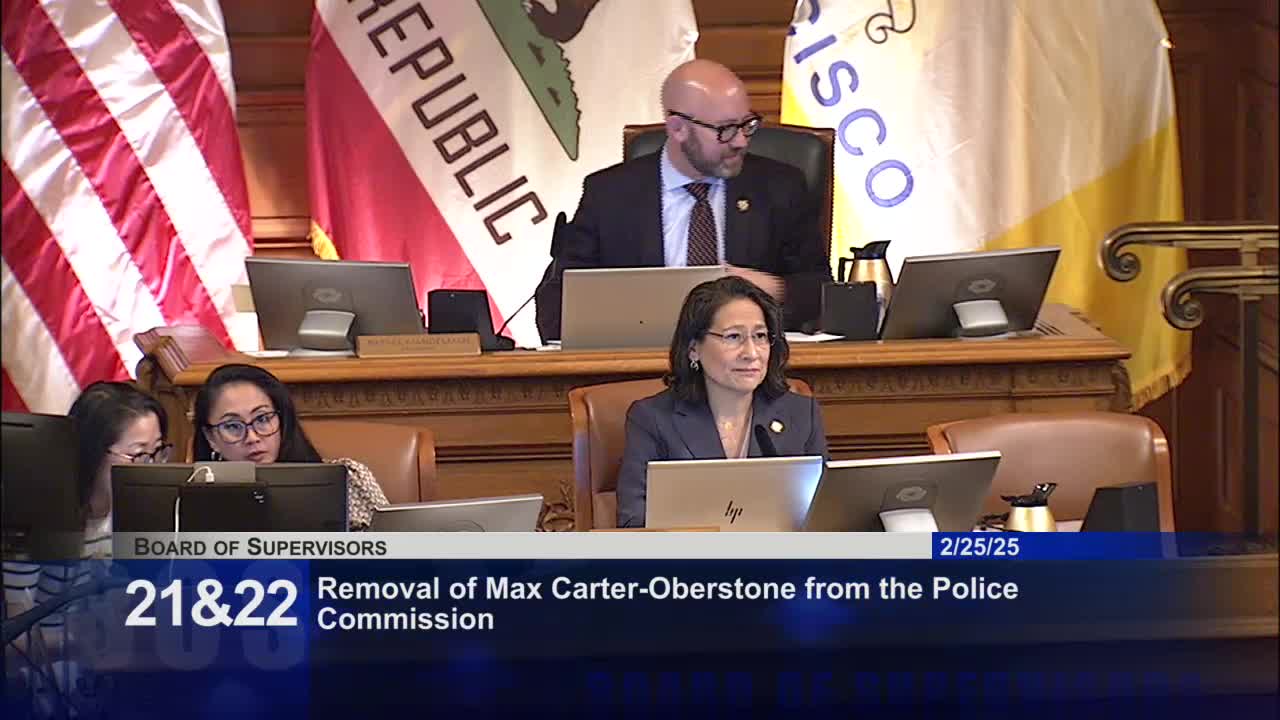
The San Francisco Board of Supervisors voted 9–2 on Feb. 25 to consent to Mayor Daniel Lurie’s removal of Police Commissioner Max Carter Oberstone, after a public hearing with hours of testimony for and against the move.
The San Francisco Board of Supervisors voted 9–2 Tuesday to consent to Mayor Daniel Lurie’s request to remove Police Commissioner Max Carter Oberstone.
The vote followed a two-hour public hearing during which Commissioner Max Carter Oberstone addressed the board and more than two dozen residents, community groups and police oversight allies urged supervisors either to reject the mayor’s removal request or allow Oberstone to finish his term.
Commissioner Max Carter Oberstone, who was given time to speak before public comment, described his service on the commission as driven by his personal history and a commitment to independent oversight. "I threw myself into this job. I approached it with the care, devotion, and seriousness that it requires," he said, adding that his work was aimed at “protect[ing] the public and defend[ing] the rule of law.”
Supporters told the board the commissioner strengthened civilian oversight of the San Francisco Police Department (SFPD), citing his work on limits to pretext stops, body worn camera policy revisions and other reforms. Organizations including the ACLU of Northern California, the San Francisco Public Defender’s Office and numerous neighborhood and labor groups urged supervisors to reject the removal.
Opponents — including the mayor’s office and some supervisors — said the mayor is entitled under the charter to appoint and remove his own selections to the commission and framed the matter as a question of executive authority and working relationships. Supervisor Matt Dorsey, who moved the board’s consent to the mayor’s removal, argued that the police commission is not a "for‑cause" commission under the city charter and that mayoral appointees are generally accountable to their appointing authority.
The roll call on the motion as amended recorded the following votes: Supervisors Bilal Mahmood, Rafael Mandelman, Aaron Peskin (recorded as Engardio in the transcript), Joel Engardio, Matt Dorsey, Connie Chan, Aaron Peskin (if applicable), and others voted aye; Supervisors Myrna Melgar and Jackie Fielder voted no. (The board clerk’s official roll call lists names and recorded votes in the meeting minutes.)
After the outcome was announced, many speakers who had urged keeping Oberstone denounced the vote and warned it would chill independent oversight. Supporters of the mayor said the city needs commissioners aligned with administration priorities to pursue a coordinated public‑safety agenda.
The board’s consent means the mayor may appoint a replacement for the seat; the removed commissioner said he would continue to advocate publicly for independent oversight.
The item before the board cited Section 4.109 of the San Francisco City Charter, which requires board approval for mayoral removals of commissioners. Legal and policy experts in public comment debated whether the charter’s design makes the police commission chiefly accountable to the mayor or to independent oversight principles adopted by voters in recent reforms.
The mayor’s office did not present evidence of malfeasance during the public hearing; the mayor’s staff framed the request as a question of collaboration and alignment with the mayor’s public safety priorities.
The board’s action is final for the moment; the mayor will proceed with appointing a successor under the charter’s procedures.
An item tied to this vote (the board’s subsequent approval on a related motion) appears in the official board record.