Get Full Government Meeting Transcripts, Videos, & Alerts Forever!
Get email alerts on the Guns Second Amendment topic
No spam. Unsubscribe anytime.
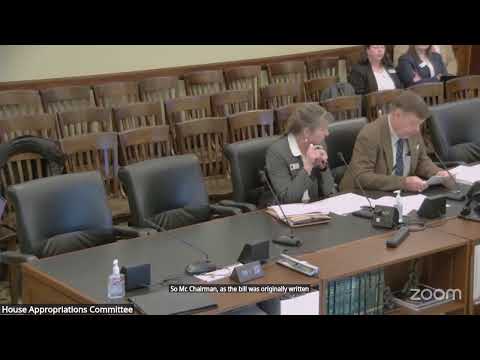
Appropriations committee advances Second Amendment Preservation Act amendment after testimony on civil penalties and ATF raid
Summary
The Wyoming House Appropriations Committee voted 6-1 to pass Senate File 196 as amended after hours of public testimony on civil penalties, officer authority and a disputed ATF raid connected to a restoration‑of‑rights letter.
The Wyoming House Appropriations Committee voted 6-1 to pass Senate File 196 as amended after several hours of testimony and debate on the measure that would reinstate criminal penalties related to federal gun-law enforcement in Wyoming and create a civil cause of action for alleged infringements.
The bill, described by sponsor Representative Lee Harrelson as amendments to the Second Amendment Preservation Act, would reinsert criminal penalties the committee said were previously in state law, add a civil remedy allowing citizens to sue agencies (not individual officers) for alleged violations and add definitional language clarifying who counts as a peace officer. The committee also adopted a severability clause to protect portions of the act if parts are challenged in court.
Why it matters: Proponents say the combination of criminal penalties and a civil path will deter agencies from enforcing federal gun restrictions in the state; opponents warned the bill could produce legal conflicts for officers who must follow state arrest statutes or respond to federal warrants and could expose local agencies to mandatory civil penalties.
Support and amendments Mark Jones, national director of Gun Owners of America, told the committee the organization had opposed the bill when it was first introduced because it initially appeared to repeal Wyoming's earlier criminal statute, but that changes made in the Senate and two amendments he proposed had made the measure acceptable to GOA. “This bill does not stop ICE immigration. This bill does not stop drug task forces. What this bill does is stops the enforcement of federal gun control,” Jones said, adding the bill should include a severability clause and clearer definitions of “officer” so there are no loopholes.
Representative Harrelson described two committee amendments he brought: a cleanup amendment to correct cross references and spelling and a second amendment that inserts the definition of “peace officer” by reference (7-2-101 A(4) as cited in testimony) in two places to clarify who the statute covers. Harrelson also read the severability clause the committee adopted, which states that if a provision is held invalid, that invalidity does not affect other provisions that can be given effect.
Concerns from county attorneys and law enforcement Joshua Stenzoz, speaking for the County Attorneys Association, said county attorneys support protecting the Second Amendment but warned the bill as written could place officers in an impossible position when federal warrants are involved. “The problem is there’s actually a statute, 6-5-115, that requires that officer to arrest on any criminal case where there’s a warrant,” Stenzoz said, arguing an officer could face criminal or civil exposure whether they arrest on a federal warrant or refuse to do so.
Stenzoz also raised scenarios in which officers lawfully ask people to set down firearms during domestic‑violence checks, burglaries or DUI responses. He said those routine officer‑safety actions could be treated as “seizures” under the proposed statute and could subject agencies to a mandatory civil penalty of $50,000 per violation. He asked the committee to give judges discretion over penalty amounts (for example, changing a required $50,000 penalty to “up to $50,000”) and to narrow or clarify which parties may bring civil suits, rather than broadly allowing any “interested party.”
Testimony from people affected by enforcement Noreen Scroggins (presenting testimony with Randy Kane) described a 2023 ATF raid that followed a restoration‑of‑rights certificate issued by executive action. She said state correction officials had told her the certificate restored firearm rights in Wyoming for those who had completed sentence and probation. Scroggins described ATF agents and local officers executing a search warrant, taking firearms and handcuffing household members; she said federal authorities told her the federal government did not recognize the governor’s restoration letters. “It was like a militia attacking us,” Scroggins said, describing officers in body armor, drones and a safe being forcibly opened.
Public testimony and policy framing Jeff Carmichael, a Johnson County resident, urged the committee to remember the law’s origins and the purpose of a Second Amendment Preservation Act — primarily, he said, to give citizens a way to hold the executive branch accountable for enforcement decisions. Several committee members said they were sympathetic to the hardships described in public testimony and that separate legislation in the House was under consideration to clarify restoration‑of‑rights letters going forward.
Committee action and next steps After debate and a series of technical and definitional amendments offered and adopted by Representative Harrelson, the committee moved the bill forward. Representative Harrelson offered the committee’s omnibus cleanup and peace‑officer definition amendment; Representative Smith seconded the motion to pass the bill as amended. The committee adopted a severability clause before final passage.
Votes at a glance Senate File 196 — Second Amendment Preservation Act amendments — Committee motion: pass as amended. Mover: Representative Harrelson; Second: Representative Smith. Committee vote: 6 Aye, 1 No (Representative Sherwood). The committee recorded the roll call as follows: Representative Aleman — Aye; Representative Angelos — Aye; Representative Harrelton — Aye; Representative Pendergraft — Aye; Representative Sherwood — No; Representative Smith — Aye; Chairman Bair — Aye.
What the committee did not decide The committee did not remove the civil cause-of-action component; it did not substitute an alternative enforcement mechanism. Members asked staff and legal counsel to consider the County Attorneys Association’s points about conflicts with existing arrest statutes and to identify where the bill might create unintended officer liability. The committee did not vote on any changes to the bill’s civil‑suit standing language beyond defeating one amendment that would have limited standing to aggrieved law‑abiding citizens.
Where it goes from here The committee chair said Representative Wharf will manage the bill on the floor. Committee members also noted a separate House bill addressing restoration‑of‑rights letters is scheduled for second reading; committee members said that measure may address at least some of the enforcement confusion described in testimony. The committee also briefly took up—but did not complete—introductory remarks on Senate File 34, a school‑maintenance funding bill, and scheduled further consideration of that measure for the next committee meeting.
(Exact statutory citations, amendments and quoted testimony were taken from committee transcript and public testimony.)