Get Full Government Meeting Transcripts, Videos, & Alerts Forever!
Get email alerts on the Court Budget And Capital topic
No spam. Unsubscribe anytime.
Kentucky Court of Justice outlines budget shortfall risks, capital projects and planned requests for judicial pay and IT fees
Summary
Administrative Office of the Courts officials told legislators about asset‑preservation spending, facilities projects and an early plan to study judicial salaries; they warned of projected shortfalls in the current biennium and described ARPA funding covering early SaaS costs for a statewide case‑management rollout.
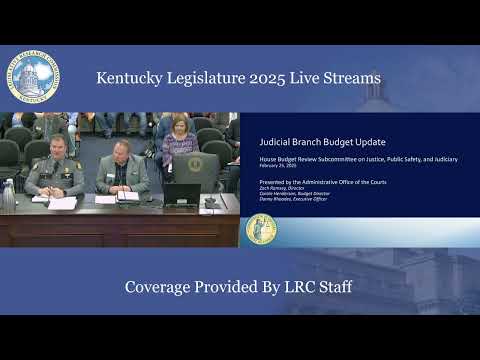
Zach Ramsey, director of the Administrative Office of the Courts (AOC), told a Kentucky House committee that the Kentucky Court of Justice is managing current appropriations while preparing anticipated budget requests for the next biennium, including judicial compensation, information‑technology subscription fees and continued facility maintenance.
Ramsey and his staff outlined several appropriation figures and program updates. He said the court operations general‑fund appropriation for fiscal year 2025 is $317,400,000. He said restricted‑fund carryforward into FY25 was roughly $51,400,000 and noted the administrative office has roughly 18 active federal grants supporting specialty courts and other programs.
Carol Henderson, budget director for the Administrative Office of the Courts, reviewed the agency appropriation units and current forecast. She said that when the office modeled FY25 expenditures using FY24 data, estimated FY25 spending was $337.5 million—higher than the legislative appropriation—creating a budgeting gap that executives are managing through temporary holds and use of restricted funds. Henderson said measures put in place included a 60‑day hold on some spending and shifting one‑time technology purchases to restricted carryforward funds to reduce the immediate deficit.
On facilities and capital projects, Danny Rhodes, executive officer over facilities, described two capital pools authorized by the 2024 General Assembly: an asset‑preservation pool and a renovation pool. He said the asset‑preservation appropriation totaled $47,080,000 and that $6,100,000 had been obligated since July 1; 70 counties had received asset‑preservation funding supporting 92 projects. Contracts for an additional roughly $12,000,000 were circulating at the time of the meeting. He said the renovation pool totaled $6,420,000, of which $2,100,000 had been obligated for projects in Jefferson, Kenton and Warren counties.
Rhodes updated the committee about the Court of Appeals capital project, for which $14,100,000 was authorized. He said site development and design had been delayed because the city and the transportation cabinet planned a roundabout that required transferring a portion of the property; the project team expects to bid the Court of Appeals building in spring 2026.
Ramsey also previewed anticipated budget requests for the next biennium. He said the chief justice has asked staff to analyze judicial salaries and do comparative work with border states and national data; early analysis places Kentucky judges near the bottom of border‑state comparisons when cost of living is adjusted. The office plans further study before formal requests are prepared.
On information‑technology spending, Ramsey said the court system is shifting from capital implementation to ongoing subscription (SaaS) fees as systems move into operation. He described two major IT projects: a statewide case‑management system that will begin piloting next year and a statewide electronic filing (file‑and‑serve) system. He said American Rescue Plan Act (ARPA) funds are being used to cover implementation costs and are expected to pay many SaaS fees through roughly 2030; after ARPA funds are exhausted, new appropriations will be needed to sustain subscription costs.
Henderson noted that the local facilities appropriation unit covers use allowances and operating costs for county‑owned buildings where courts sit; payments to counties increased by about 9 percent from FY22 to FY23, producing a projected $4.5 million shortfall in the local facilities budget as estimated in the presentation. She said audits for FY24 were pending but would inform final adjustments to county payments.
Committee members asked for copies of the handouts and for additional documentation on fines and fees remitted by circuit clerks; officials clarified that clerks remit collected fines and fees to the Finance Cabinet rather than to the Administrative Office of the Courts.
Ramsey closed by asking legislators to consider probable future requests that will include judicial compensation adjustments, ongoing SaaS fees for IT systems, continuing nonrecurring facility maintenance funds and potential capital projects for counties with structural facility issues such as Boyle and Lincoln counties. He said more detailed requests would arrive in formal budget proposals in the run‑up to the next biennial budget cycle.