Get Full Government Meeting Transcripts, Videos, & Alerts Forever!
Get email alerts on the Transportation Plan topic
No spam. Unsubscribe anytime.
Mooresville holds work session on Mobility Plan: consultants outline CTP amendments, intersection priorities and public engagement
Summary
Consultants and town staff presented the Mooresville Mobility Plan work session, outlining technical findings, a public-engagement schedule and next steps toward a June 2025 adoption of an updated town-level CTP.
Town staff and consultants led a work session on the Mooresville Mobility Plan, a CRTPO‑funded study that will update the town’s Comprehensive Transportation Plan (CTP), produce prioritized projects for sidewalks, greenways and new roadway connections, and develop conceptual intersection designs and cost estimates for selected locations.
Erica Martin (Planning & Community Development) introduced Erin Musial, senior planner and project manager with RSNH, and Sophie King, a transportation planner who is working with the town from CDOT. Musial summarized the project scope, explained the plan’s role as the town-level CTP that feeds candidate projects into the MPO Metropolitan Transportation Plan (MTP) and NCDOT’s transportation-improvement processes, and described the schedule: three steering‑committee meetings have been held, one round of public engagement was completed in fall 2024, a second round is planned for April, and staff aims to bring a package to the board for adoption in June 2025.
Musial said the plan’s technical work included: an existing-conditions analysis using the regional travel-demand model (MRM), crash and safety data (including references to the town’s Vision Zero work), current and forecast traffic volumes through 2055, and a gap analysis of existing and planned projects. Public outreach yielded nearly 500 online survey responses and about 80 in-person contacts at a community event; an interactive map captured citizen comments and requested connections.
The consultant team screened intersections townwide and recommended three locations for more detailed conceptual designs and cost estimates (the team also carried a larger screening list). Musial said the steering committee and staff prioritized intersections that are not already funded or programmed, and that conceptual designs will include itemized cost estimates. Musial and commissioners discussed one intersection where an NCDOT estimate exceeded $20 million; consultants said the plan will offer tiered or prioritized components so the town can pursue discretionary grant funding where feasible.
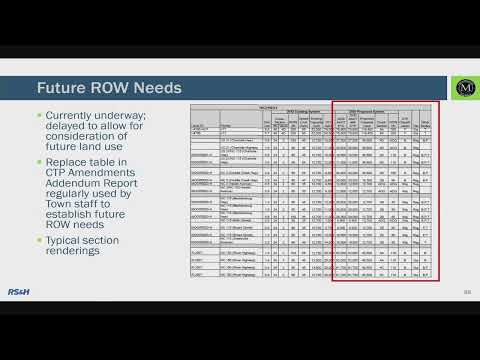
Other plan components described were functional-classification updates (to align town streets with FHWA/NCDOT eligibility and the MTP), a prioritized list of new roadway connections (18 candidate connections were refined after feasibility screening), and prioritized greenways and sidewalk segments with three segments to be selected for concept design. Musial noted the plan will update future right‑of‑way and typical-section tables to match the town’s preferred land-use scenario from the concurrent Mooresville Tomorrow comprehensive plan; CDOT re-ran the travel-demand model with the town’s preferred scenario to sync forecasts.
Commissioners asked for clarifications about how projects move from the town CTP into the MPO MTP and then the NCDOT TIP. Commissioner Qualls emphasized the need for public comments on the MTP/TIP public‑comment portals to improve projects’ chances of funding. Several commissioners asked that staff provide a list showing which high‑complaint intersections already have improvements in the pipeline so ward representatives can communicate progress to constituents.
Musial said the next steps include completing three conceptual intersection designs and cost estimates, holding the second public-engagement round in April, finalizing project sheets for candidate roadway and greenway projects, and returning the full plan for board consideration and anticipated adoption in June 2025.