Get Full Government Meeting Transcripts, Videos, & Alerts Forever!
Get email alerts on the School Transportation topic
No spam. Unsubscribe anytime.
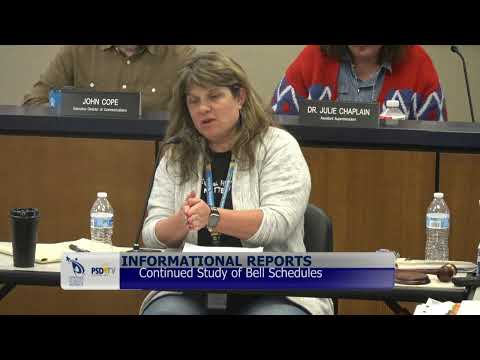
Board pauses major bell‑time changes after lengthy transportation briefing; asks staff for follow‑up study
Summary
Following a technical briefing, the Poudre School District board declined to change bell times Feb. 25 and directed staff to study operational alternatives — such as grouped secondary stops, co‑transporting middle and high students, and boundary effects — then return with costed options after the new school year begins.
The Poudre School District R‑1 Board of Education did not adopt new bell times at its Feb. 25 meeting after a detailed presentation from First Student Consulting and district transportation staff. Instead, the board asked district staff to analyze a broader set of delivery options and to report results after the start of the next school year.
Transportation findings. Colton Graham of First Student Consulting told the board that the district’s geography — roughly one and a half times the area of Rhode Island, with long rural routes — constrains efficiency. Staff explained the current schedule relies on a “v‑shaped” trip design (middle schools early, a set of elementaries staggered in the middle, and high schools latest) to create triple trips where possible. Graham said several alternatives the board requested — swapping middle‑ and high‑school start windows, moving the entire system 15 minutes, and other permutations — produced many more required routes and thus would not remain cost neutral without other changes.
Why simple shifts don’t solve it. Staff explained the core constraint: different school day lengths (high schools reported 22 minutes longer in the example cited) combine with long run times so a bus finishing a high‑school run cannot reach elementary routes in time to create triples. Graham and transportation staff recommended a set of potential levers the district could study to reduce routes, including group stops for secondary students, co‑transporting some middle‑ and high‑school students, adjusted boundary or stop clustering, selective use of city transit or alternate transport for remote stops, and other operational changes.
Board direction. After extended discussion and public comment, the board agreed not to adopt new bell times at this meeting. Instead the board asked staff to: - Pause immediate changes and allow transportation staff to complete summer‑school routing and the start‑of‑year routing work; and - Conduct a structured study of specific options (co‑transporting middle/high routes, group/cluster stops, selective use of alternate transport, and boundary implications), then report findings back to the board early in the school year. Several board members asked staff to include cost estimates, student‑impact analysis (including extracurriculars and after‑school care), and a clear timeline for any recommended change.
Concerns and tradeoffs. Board members and principals described tradeoffs: later high‑school start times can reduce teen sleep deprivation but push after‑school activities later, complicate student employment and family schedules and reduce time for evening work; earlier starts can stress families and staff. Several directors urged a thoughtful, longer‑range process because repeated changes to bell times are disruptive; others emphasized the need to act sooner if families overwhelmingly prefer a small time shift. Transportation leaders said the deeper analysis will take time and staff capacity but is feasible if prioritized.
Next steps. District staff said they will return with a ranked set of operational options and cost estimates after the start of the next school year and recommended coordinating any large changes with boundary or programmatic planning to avoid multiple major shifts in a short time frame.