Get Full Government Meeting Transcripts, Videos, & Alerts Forever!
Get email alerts on the Parks Recreation topic
No spam. Unsubscribe anytime.
Richland outlines phased reopening after extensive cleanup of closed parks
Summary
City parks staff described closures of Columbia Park West and other shoreline areas after vandalism, fires and recurring camping; staff outlined a two-phase reopening, increased ranger patrols, vegetation work approved with U.S. Army Corps and weekly visits by a county resource navigator.
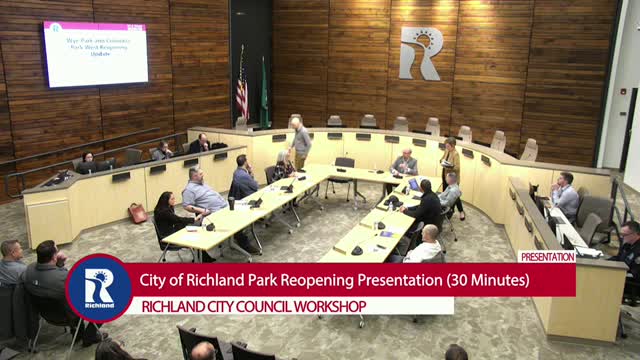
City parks staff briefed the council on the closure and planned phased reopening of Columbia Park West and adjacent shoreline areas after months of vandalism, fires, litter and recurring unauthorized camping.
Chris Waite, a city parks staff member, told the council the department closed the affected area only after other measures — extra ranger patrols, police support, closure of damaged restroom facilities and signage — failed to stop repeated problems. "Our responsibility as a department is really to provide a safe space for our community members to come and recreate," Waite said, framing the closure as a last resort to protect visitors and natural resources.
Waite summarized work done during the closure: an extensive shoreline cleanup that took nearly a week; vegetation management completed in December and January after approvals with the U.S. Army Corps of Engineers and the city planning department; removal of low Russian-olive branches to reduce hiding places; and disposal procedures for belongings found at abandoned campsites (items bagged, labeled and stored for 60 days). He said the city recorded 26 substantial camps in the roughly 10 months prior to the closure and that staff frequently found hypodermic needles and other drug paraphernalia during cleanup.
Staff reallocated responsibilities to increase time park rangers could spend on patrol. Waite said the parks department currently staffs one full‑time park ranger, two overlapping seasonal rangers and one intermittent ranger for a peak complement of four; the department reassigned non‑patrol tasks (shelter postings, event prep, dog‑waste service) to other employees so rangers could focus on field patrols. Benton County work crew support was prioritized for cleaning abandoned camps and high‑need areas.
For reopening, the department proposed a two‑phased approach that begins on the east side of the closed area, increases visible ranger patrols, and reinstates discretionary evening patrol emphasis in partnership with the Richland Police Department. Waite said the city intends to restart weekly interagency site visits with a Benton County resource navigator; initial meetings have been held and staff plan to replicate the county’s outreach model inside city parks. He described the reopening as contingent on continuing close cooperation with police and county human services.
Councilmembers asked how proposed state legislation (referred to in the meeting as "bill 1380") could affect the city’s ability to address camping in public spaces; city staff said they have informed the city’s lobbyist and legislators of the council’s opposition and are monitoring the bill. Several council members asked the city to provide more public-facing communications about why the parks closed, the steps taken during closure and the reopening timeline. Waite said staff will work with the city’s marketing and communications team to publish the reopening timeline and will expand outreach to nearby businesses and frequent park users.
Waite said the city will consider longer-term riparian restoration to replace invasive Russian olive with native plantings, but noted such ground-disturbance work requires a minimum six-month review and specific approvals; the long-term restoration was described as a potential second step if conditions after reopening warrant it.
Council members praised the reallocation of ranger duties and urged proactive public messaging; staff said they will return with additional updates if reopened conditions worsen and with any future funding requests to increase ranger staffing or add technology to reduce the risk of repeat closures.