Get Full Government Meeting Transcripts, Videos, & Alerts Forever!
Get email alerts on the Communications Rights Of Way topic
No spam. Unsubscribe anytime.
Longwood commission approves first reading of ordinance requiring cash escrow for new communications work in rights-of-way
Summary
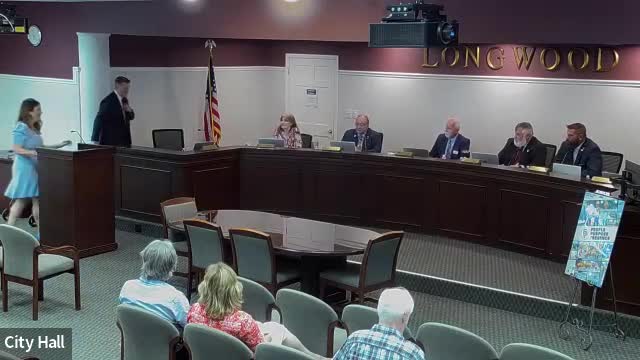
The Longwood City Commission on May 29 approved the first reading of Ordinance No. 25-2269, a change to the city code that would require cash escrow deposits for certain new telecommunications installations in public rights-of-way and add explicit stop-work authority for the city.
The Longwood City Commission on May 29 approved the first reading of Ordinance No. 25-2269, a change to the city code that would require cash escrow deposits for certain new telecommunications installations in public rights-of-way and add explicit stop-work authority for the city.
The ordinance, read by the city attorney at the meeting, amends chapter 7.d.8, article 2 (Communications Facilities and Public Rights-of-Way) to define “construction bond” as a cash escrow posted with the city for new installations, with a $25,000 escrow required for projects shorter than 500 linear feet and $250,000 for larger projects; the ordinance allows a letter of credit for small projects and says escrow will be held for 200 days after project completion.
City Attorney Dan Langley, who presented the measure, said the change codifies the local definition of a construction bond that state law authorizes but does not define. “We're only gonna use it if they don't fix the damages that they're legally obligated to fix to begin with,” Langley said. He described the proposal as a protection to ensure telecommunications companies repair damage their work causes to city infrastructure, and said the deposit is refundable if the permit holder completes required repairs.
Charter Communications (Spectrum) representative Kate Wallace addressed the commission before the ordinance was moved up on the agenda. “We are here to ask if we could table the ordinance as written and proposed today and not allow it to progress from a first reading,” Wallace said, citing concerns about the cash-escrow requirement and indemnity language. Wallace told the commission that requiring cash in escrow could remove operating funds the company needs for network upgrades and for emergency repairs after damage to infrastructure.
Public works director Chad Smith and multiple commissioners described repeated incidents in which contractors working in the right-of-way damaged utilities. Smith said crews have responded “30, 40 times” to strikes on lines and that repairs consume city resources. Several commissioners said the escrow would create “skin in the game” and reduce carelessness by contractors.
Deputy Mayor Abby Shoemaker moved to advance the item on the agenda; Deputy Mayor Shoemaker’s motion to move 12.b forward was seconded by Commissioner Tony Boney and carried. After discussion and brief comment from Charter and staff, Commissioner Boney moved to approve first reading as written; Commissioner Matt Morgan seconded. The commission called the roll for first-reading approval and the vote was recorded as unanimous: Mayor Brian Sackett, Deputy Mayor Abby Shoemaker, Commissioner Tony Boney, Commissioner Matthew McMillan and Commissioner Matt Morgan all voted yes. The second reading and public hearing were set for June 2, 2025.
The ordinance text, as presented, narrows the requirement to new installations (not routine repairs or coordinated public agency projects), requires owner authorization for permit applicants so the city can hold the facility owner responsible, and provides limited flexibility for multiple concurrent projects by the same permit holder. Langley said the city is not imposing a tax or fee — the funds would be held in escrow and returned if permit conditions are met — and that the city will still be able to pursue remaining liability against a company if damages exceed the deposit.
Spectrum asked the commission to table the measure and requested additional meetings or a workshop to discuss technical and legal concerns. Langley said he was willing to meet with Spectrum and other stakeholders before the second reading.
The ordinance establishes stop-work order authority for permit violations and sets parameters the attorney said are less restrictive than a similar ordinance in another Florida city. The City Clerk confirmed the item will return for a public hearing and second reading on June 2.
Votes and next steps: the commission approved the ordinance on first reading and set the second reading/public hearing for June 2, 2025. The city attorney said he would meet with interested providers before the second reading if the firms wish to provide additional input.
— Bylined reporting drawn from the May 29, 2025 Longwood City Commission meeting transcript. No final adoption occurred at this meeting; the ordinance was approved on first reading only.