Get Full Government Meeting Transcripts, Videos, & Alerts Forever!
Get email alerts on the Land Use topic
No spam. Unsubscribe anytime.
Planning commission recommends denial of Madrone Village annexation and preliminary plat after public debate on traffic and schools
Summary
Commissioners voted to recommend denial of a developer’s application to annex roughly 79 acres for the Madrone Village subdivision and related preliminary plat and design review after public concern about traffic impacts at 10 Mile and Kuna roads and school capacity.
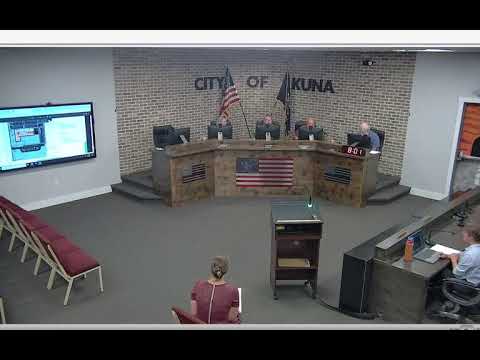
The Kuna City Planning and Zoning Commission voted Tuesday to recommend denial of an annexation, preliminary plat and design‑review package for the Madrone Village subdivision, a proposed development on about 79 acres south of the railroad and near 10 Mile and Kuna Road.
Troy Beheunen of the City of Kuna’s Development Services Department told the commission the application requested annexation of approximately 79 acres into Kuna with zoning changes to R‑6 (medium‑density residential) and C‑1 (neighborhood commercial). The applicant proposed a preliminary plat with roughly 354 single‑family lots in earlier filings; subsequent revisions increased and then adjusted the lot mix, with the applicant later stating the overall lot count changed “from 414 to 409.” The tentative plan also included a school lot, a city park and multiple common lots.
Stephanie Hopkins, representing the applicant’s engineering team, told the commission the project had obtained an accepted traffic impact study from the Ada County Highway District and that the developer worked with Boise Project Board of Control to relocate a 40‑foot irrigation easement along Sunbeam and Bead Lily frontages. Hopkins said the final ACHD staff report reflected prior draft recommendations and that the applicant had modified lot sizes and added a pocket park and pathways at the commission’s request.
Public testimony included several residents and representatives who urged care on traffic and school impacts. Tim Jensen, principal at Fremont Middle School and representing Kuna School District 711, said the district remains over capacity and reiterated the school district’s position opposing the application. Resident speakers raised concerns about added traffic at the 10 Mile intersection, the potential for Sunbeam or Ash Avenue to become cut‑throughs, noise, and construction impacts. One resident also urged the commission to avoid approving additional nearby battery energy storage (lithium) facilities and “5G” towers until codes and safety standards were updated.
Developer Tim Eck said the project would add two new access points to Kuna Road, add turn lanes and other intersection features, and provide a charter school site on the property. Eck said the charter school would not serve all K–12 grades but estimated the school’s planned capacity “would build out accommodate approximately 3 times the amount of students that will be produced by our subdivision,” a claim he made in rebuttal to school district concerns. The applicant also noted a donation of a fire station lot to the Kuna Rural Fire District.
Commissioners discussed the balance of infrastructure benefits — donated land for a fire station, a proposed charter school and on‑site parkland — against unresolved traffic concerns and the regional load on Kuna schools. Several commissioners said they were “torn” but ultimately supported the motion to recommend denial, citing uncertainty over traffic impacts at 10 Mile and Kuna Road, the railroad crossing, and the time phasing of construction and mitigation.
A motion to recommend denial of the annexation, preliminary plat and design review (case numbers 24‑05‑S, 24‑08‑AN and 24‑23‑DR) was made and the commission voted in favor. The motion passed by voice vote with all commissioners present supporting the recommendation to deny; the record does not contain a roll‑call tally of individual member votes.
Because the planning and zoning commission issues recommendations to the city council, the denial recommendation now proceeds as a formal record for council consideration; the commission did not adopt binding conditions to approve the project.