Get Full Government Meeting Transcripts, Videos, & Alerts Forever!
Get email alerts on the Transportation topic
No spam. Unsubscribe anytime.
ITD presents SH‑69 corridor vision calling for seven‑lane widening, raised medians and multiuse paths
Summary
Idaho Transportation Department staff outlined a corridor study for State Highway 69 that forecasts large traffic growth, identifies safety hot spots and proposes a seven‑lane cross section with raised medians and 10‑foot multiuse paths; no construction funding is yet identified.
The Idaho Transportation Department outlined a long‑range vision for State Highway 69 on Tuesday, presenting traffic forecasts, crash history and conceptual cross sections that include widening portions of the corridor to seven lanes with continuous raised medians and separated 10‑foot multiuse pathways.
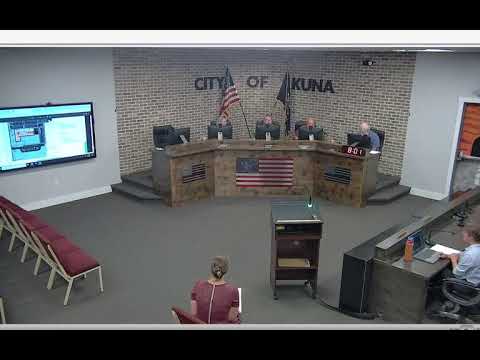
The presentation to the Kuna City Planning and Zoning Commission was led by Mark Wostel of the Idaho Transportation Department and Megan Romanescu of DKS Associates. Wostel summarized the project history and schedule, saying, “We started our project in 2019,” and that the team is “expecting to probably finalize the traffic study next month.” Romanescu presented volumes and crash data, noting existing north‑south volumes near 37,000 vehicles per day and a 2050 forecast that “are expected to more than double and be about 77,000” vehicles per day on the highest‑volume segment.
The study team described two broad corridor cross‑sections. For the north‑south segment, the proposed concept would widen from five to seven travel lanes with a continuous raised median (about 18 feet in the concept shown), three 12‑foot lanes in each direction, 8‑foot shoulders and right‑turn lanes at intersections. The plan also calls for a 10‑foot, buffer‑separated multiuse path on each side of the corridor. For the east‑west (Avalon) portion, the concept would generally provide five continuous lanes with a two‑way left‑turn lane in less urbanized stretches and attached sidewalks in denser segments.
Romanescu reviewed safety data for 2019–2023: “We did a summary of all the crashes on 69 between 2019 and 2023, and there were 579 crashes,” with 47 percent classified as serious (injury or fatal), higher than Idaho’s statewide 31 percent rate for all roadways in 2023. The presentation identified five fatalities on the corridor during that period and said three of the five involved drug or alcohol impairment.
Public feedback from an April virtual open house was summarized by the consultants: 1,900 visitors to the online site, 135 comment forms, 18 emailed or telephoned comments, and a split of roughly 55 percent in favor, 29 percent opposed and 16 percent neutral. Support was strongest for adding capacity and right‑turn lanes; opposition focused on loss of access from raised medians and concern that building more lanes could induce more traffic.
The study team said some high‑capacity, nonstandard intersection treatments considered earlier—examples cited included continuous‑flow or median‑u‑turn options—were removed from the preferred set after internal review and limited agency support. Wostel said ITD paused some options while watching separate projects that tested nonstandard designs. The study also considered coordination with Ada County Highway District on potential cooperative projects at constrained intersections such as Overland Road, and with COMPASS regional forecasts (the presentation used a 2050 COMPASS forecast).
The department noted special constraints in several locations: limited right‑of‑way, steep cut and fill slopes and a section known locally as the Kuna Curve. The consultants said some locations likely will require additional right‑of‑way or easements to accommodate turn lanes, drainage and multimodal facilities. Wostel said the project does not yet have identified construction funding inside ITD’s seven‑year program and that a regular maintenance project is scheduled for 2029; he also described a developer‑linked revenue agreement under negotiation (a draft discussed as an anticipated revenue agreement with Brighton Development for up to $35,000,000 in improvements) but said final terms were not complete.
Commissioners and members of the public asked about causes of crashes at several locations, who would maintain off‑right‑of‑way landscape buffers and whether planned pedestrian facilities would require additional property acquisition. Romanescu said rear‑end crashes were the most common collision type and that adding right‑turn lanes would help reduce those. On ownership, Wostel said his district engineer advised that state code does not permit ITD to maintain pedestrian facilities in all cases and that responsibility for maintenance often is resolved during design and intergovernmental coordination.
Wostel and Romanescu emphasized that the corridor document is a planning‑level traffic and vision study, not a construction contract, and that it is intended to guide future design, property planning and coordination with cities and ACHD. They told the commission the final study is expected soon and said ITD will continue agency coordination before any construction phase is programmed.
The commission did not take formal action on the ITD presentation. Commissioners and residents asked follow‑up questions about funding, timelines and potential changes at key intersections such as Overland Road and the I‑84 interchange.