Get Full Government Meeting Transcripts, Videos, & Alerts Forever!
Get email alerts on the Native Hawaiian Loan Fund topic
No spam. Unsubscribe anytime.
OHA trustees hear update on Native Hawaiian revolving loan fund, staffing and budget request
Summary
Office of Hawaiian Affairs staff presented results, staffing needs and a $2.4 million budget request for the Native Hawaiian Revolving Loan Fund (NARF), and discussed efforts to remove federal oversight so the program could access different investments and products.
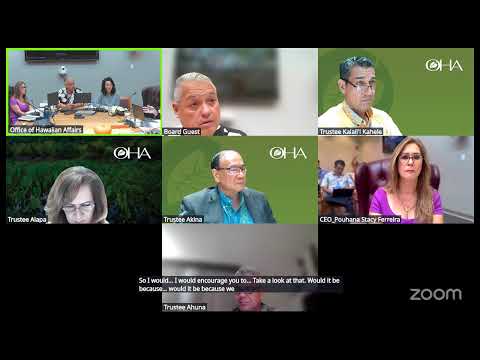
The Office of Hawaiian Affairs on May 20 heard a presentation on the Native Hawaiian Revolving Loan Fund, known as NARF, covering the program's history, recent lending activity, staffing gaps and a proposed $2.4 million budget for the program.
NARF, established in 1989 through a partnership with the Administration for Native Americans (ANA) and the Office of Hawaiian Affairs (OHA), began with roughly $22.8 million in seed funds (about $12.9 million from ANA and $9.9 million from OHA). Presenters told trustees that, as of April 2025, the program has closed about $77.8 million in loans since inception and currently has roughly 500 active loans outstanding, most with seven-year terms. The program reported sizable year-over-year growth in loan counts: 21 loans in fiscal 2021, 57 in fiscal 2022, 69 in fiscal 2023 and 125 in fiscal 2024; fiscal 2025 year-to-date was reported as 81 loans.
Robert Carbo, introduced at the meeting as a loan processor for NARF, and other program staff described the fund's consumer and business products, including a consumer microloan line, a Malama loan for startups and expansions, a larger Hual business loan for firms with about three years of growth, and a Mahi'ai agricultural loan. Staff said the Mahi'ai product includes a roughly six-month payment deferral to allow new farmers time to begin generating income; staff also said no Mahi'ai loan had closed in fiscal 2025.
Trustees pressed staff on program performance and capacity. Program staff said the loan loss rate across product lines is about 7 percent. Trustees and staff agreed the program's staffing shortfall constrains operations; presenters said three positions were vacant (including the loan manager role, vacant since July 2024) and an independent accounting consultant is covering finance functions pending a hire. Staff said the loan manager position is posted and that the organization is working on recruitment and compensation adjustments, including potential signing bonuses, to attract candidates.
Staff presented a proposed NARF budget request of $2,400,000 for the next biennium, with personnel shown as the largest line at $1,300,000. Other line items discussed included program costs ($400,000), contracts ($400,000), overhead (about $186,000), equipment (about $72,000) and travel (listed in the presentation materials). Presenters said the contracts total includes external audit fees, outsourced underwriting, technical assistance, credit reporting and legal review; the slide descriptions in the packet did not fully match those intended categories, a discrepancy staff acknowledged.
A recurring theme in the discussion was the program's federal oversight by the Administration for Native Americans (ANA). Staff and trustees said ANA oversight limits allowable investments and some product types (staff noted mortgages are excluded under current federal guidelines). Because NARF's investable cash is held in Treasury bills under ANA rules, staff said returns on the investment portfolio are modest; presenters estimated roughly mid-single-digit returns on current investments and said moving the funds into the Native Hawaiian Trust Fund would likely yield higher returns (staff said this change would require Congressional action and an act of Congress to remove ANA oversight).
Trustees asked about extending NARF-style products to Native Hawaiians living on the U.S. mainland; staff said current ANA operating guidelines require residency in the State of Hawai'i and also require a percentage of Hawaiian ownership for business borrowers, limiting eligibility for some diaspora applicants. Staff said changing that would require revising federal guidelines or removing the fund from ANA oversight.
Staff described outreach that has increased applications, including presence at community events such as Merry Monarch; they said outreach correlates with higher application volumes in following weeks. Trustees also discussed use of OHA trust resources for complementary programs (for example, down-payment assistance pooled with partner banks) and asked staff to bring follow-up proposals on potential trust-funded lending or hybrid grant/loan products for borrowers who fall outside NARF's current eligibility.
No formal action or vote was taken on the NARF budget request at the meeting. Trustees asked staff to return with follow-up information about recruitment progress, the feasibility and legal pathway for removing ANA oversight, the viability of expanding products (including whether mortgage products could ever be offered absent federal restrictions), and proposals for trust-funded programs or recycled loan funds that would operate outside ANA constraints.
The discussion took place during the OHA Board of Trustees meeting; staff said the board will continue consideration of budget items including NARF in the next day's agenda for the proposed biennial budget planning for fiscal 2026-27.