Get Full Government Meeting Transcripts, Videos, & Alerts Forever!
Get email alerts on the Economic Development topic
No spam. Unsubscribe anytime.
Bend advisory board hears plans for council economic-development goals, urban renewal site-specific program
Summary
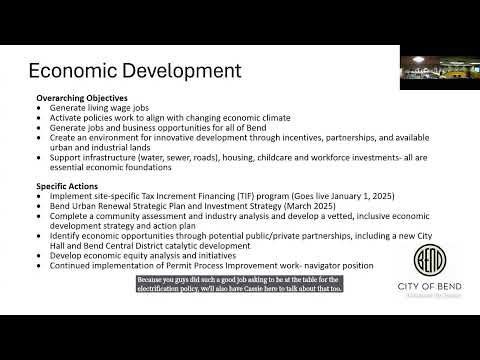
City staff outlined possible council goals emphasizing economic development, previewed a site-specific tax-increment financing program opening Jan. 1, and said a target-sector analysis will be finalized in February to guide future incentives and infrastructure planning.
City staff presented ideas for possible council economic-development goals and summarized near-term initiatives including a site-specific tax-increment financing (TIF) program opening Jan. 1, target-sector and neighborhood market analyses, and planning work to inventory available employment land.
Cyrus (board facilitator in the meeting) and staff said the City Council and city manager’s office have expressed interest in adding an economic-development-focused goal during upcoming council goal-setting, and staff will discuss concepts at an advisory-body summit on Jan. 14 and council retreat in February.
Jonathan, representing the Urban Renewal Agency, said the site-specific program will open Jan. 1 and that preliminary interest has already emerged. “We probably have 8 individuals or projects that are interested in applying, which I think is gonna total 743 apartments,” Jonathan said, noting the application window and program guidelines were still being finalized.
Staff said a target-sector analysis — which identifies industries the city wants to support — will be finalized in February and will feed an economic-opportunity analysis and infrastructure planning for water, wastewater and transportation. Damian, speaking for growth-management staff, said the work would inventory employment land and forecast employment growth over 20 years to inform comprehensive-plan updates and infrastructure planning.
Why it matters: Staff framed the proposed council goals as tools to support living-wage job creation, align policy with changing economic conditions, and deploy public-private tools such as urban renewal, incentives and infrastructure investments. The city seeks board input on which parts of the economic ecosystem (for example, workforce development, childcare, or core-area revitalization) council should prioritize.
Program specifics and next steps: Staff said the Urban Renewal Agency expects to present a rough draft investment strategy in March focused on five investment areas (affordable housing, neighborhood reinvestment, etc.). A neighborhood market analysis would start only if council approves funding in a new biennium (targeted start July 1). Staff also discussed converting an existing position into a development navigator to help complex applicants through permitting and incentive processes.
Board feedback: Members asked for clearer data earlier in the process so they can craft informed recommendations and suggested using members’ subject-area strengths to lead focused work. Several members urged staff to provide materials well in advance and to use a consistent analytic lens when reviewing economic-development tradeoffs.
Ending: Staff asked board members to identify which parts of the economic ecosystem they want to prioritize at the advisory-body summit and said the Jan. 6 meeting will include the consultant team’s review of the target-sector analysis.