Get Full Government Meeting Transcripts, Videos, & Alerts Forever!
Get email alerts on the Debt Free Mill Levy topic
No spam. Unsubscribe anytime.
PSD details first-year uses of debt-free mill levy; board told investments will be "transformational"
Summary
Officials outlined how the district plans to shift $21.5 million in existing operations into a new fund, allocate $22.9 million annually for facilities maintenance, dedicate $15 million for competitive wages and $4 million for small‑school support, and begin project work this summer.
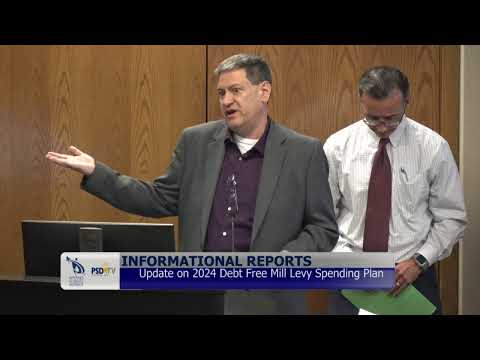
Poudre School District R-1 on Feb. 11 gave board members a detailed update on the district’s first collection of the 2024 debt-free mill levy and the planned spending for fiscal 2025–26 and beyond.
Dave Montoya, the district chief financial officer, said the levy creates a dedicated fund (Fund M) that will allow the district to transfer existing operations and maintenance staffing and budgets — roughly $21.5 million — into the new fund and free general-fund dollars for wage and programmatic investments. "The debt free mill levy will provide an additional $22,900,000 that we currently are not spending toward [facilities maintenance], and that's gonna be transformational for this district as we move forward," Montoya said.
Montoya outlined the major allocations the district intends to support annually once the mill levy is fully in place: about $22.9 million for facilities maintenance (electrical, plumbing, HVAC replacements, building systems and fleet), $15.0 million put toward competitive wages for all employee groups (to be added to salary schedules), $4.0 million for small-school support and programming, $2.5 million for high‑quality instructional materials and replacement cycles, and a charter school pro‑rata allocation (about $4.6 million) to charter partners.
Montoya noted cash‑flow timing limits the district’s ability to begin some large projects immediately, but the district distributed a one‑time 5% payment to staff on Jan. 31 using available cash. He described near‑term projects targeted for summer 2025 — rooftop units, air‑conditioning projects, boiler work, fire alarm replacements, building automation system upgrades, carpeting and flooring, parking lot repairs, track and field replacement and playground work — while noting some roofing projects may require design and then construction in summer 2026.
Dr. Tracy Guile, lead assistant superintendent, described how district leaders developed the $4 million small‑school support model with principal input. The committee recommended a three‑tier approach: (1) a $1 million fund for the smallest schools (under 200 students) with zero‑based budgets principals would design with assistant superintendents; (2) a $2 million stabilization/foundation pool to reduce year‑to‑year variability and preserve essential services; and (3) about $1 million to increase centrally funded assistant‑principal staffing and provide additional classified or licensed time in schools under 400 students (and under 700 at the secondary level). The additional per‑school allocation was described as approximately $67,000 to supplement small schools’ staffing where needed.
Guile and two principals who served on the committee, Steve Apodaca (Putnam Elementary) and Kristen Stolte (Linton Elementary), said principals provided iterative feedback and the plan will flow into next year’s school-based budgets. The district plans to post a detailed five‑year project list on its website and convene a debt‑free mill levy oversight committee in spring 2025 to review expenditures; that committee will meet at least twice annually and report to the board.
Board members asked for details about how priorities are set, how projects are escalated or reprioritized if conditions change and whether the district will track cost escalations and efficiency gains for newer systems. Montoya said McKinstry’s engineering inventory informed the initial list of needs, and district staff are refining costs and prioritization internally. "We are looking at efficiencies. When we bring the designers in, we're not just doing like for like. We're looking at new models," Montoya said.
Board directors and presenters thanked voters for approving the levy and said increased, predictable funding will allow the district to address deferred maintenance needs while boosting staff compensation and supports for smaller neighborhood schools.
The presentation concluded with the district noting the oversight committee membership and reporting materials will be posted on the levy webpage.