Get Full Government Meeting Transcripts, Videos, & Alerts Forever!
Get email alerts on the Roads And Infrastructure topic
No spam. Unsubscribe anytime.
Rockwall County auditor: $2.9M available in road bond fund; court agrees to needs assessment and to finalize project contracts
Summary
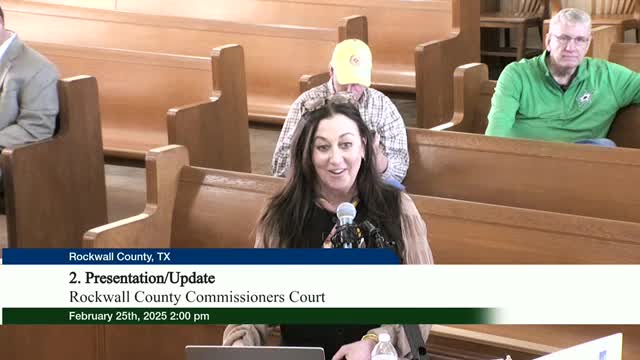
Lisa Constant Wiley, Rockwall County auditor, told the Commissioners Court on Feb. 25 that about $2.9 million in cash remains available in the county—s road bond fund after accounting for encumbered and assigned projects.
Lisa Constant Wiley, Rockwall County auditor, told the Commissioners Court on Feb. 25 that about $2.9 million in cash remains available in the county—s road bond fund after accounting for encumbered, contracted and assigned projects, interest earnings and outstanding obligations.
Wiley summarized the county—s bond authorizations and issuances and reviewed specific encumbrances, assigned projects and items that her office and county consultants say need additional funding before contracts can be finalized. She urged the court to treat the numbers on her spreadsheet as the best available accounting of funds and encumbrances.
The presentation matters because the court and its road consortium are considering how to use remaining bond cash, whether to accelerate projects, and how to balance leveraging TxDOT partnerships with doing county-controlled work. Commissioners and consultants agreed to several next steps, including finishing negotiations on pending engineering contracts, circulating an electronic spreadsheet of the bond accounts, and asking the consortium to perform a countywide needs-based assessment that will produce prioritized candidate projects for the available funds.
Wiley reviewed the three voter bond authorizations that underlie the county—s road funding: the 2004 authorization ($17,250,000), the 2008 authorization ($100,000,000) and the 2021 authorization ($150,000,000). She said the county has issued bonds from the 2008 authorization and that the 2021 authorization remains an available issuance authority (no bonds had been sold from that 2021 authorization as of the meeting). She also reviewed a separate jail bond issuance approved by voters in November 2018 and sold in 2020 for $50,270,000; Wiley said interest earned and a city reimbursement left roughly $800,000 available in the jail bond account for sheriff—s remodel work.
On road-bond funds specifically, Wiley presented a consolidated bank balance of about $28.5 million. From that total she identified roughly $9.5 million in contractual obligations (interlocals and signed contracts), $5.9 million of encumbrances remaining on Crenshaw Road (including $4.0 million originally paid by the county and $4.0 million contributed by Royse City Independent School District, for a total $8.0 million project obligation), and roughly $5.5 million in projects that had been assigned by the court in January 2024 but not yet contracted. After those items and projected additional needs on several projects, she said, the available cash balance was about $2.9 million.
Wiley distinguished administrative terms for the court: "authorized" (voter authorization to sell bonds), "issued" (bonds sold to investors), "encumbered/contracted" (funds set aside under a contract), "assigned" (internal accounting designation identifying a project the court intends to fund but not yet under contract) and "transferred" (auditor movement of unencumbered monies between projects after court approval). She emphasized the practical difference between assigned funds shown on an internal spreadsheet and legally encumbered funds that cannot be reallocated until contracts are closed. "The minute this court acts on anything, I assign those funds," Wiley said, explaining her internal accounting practice.
Marty Hsu, financial adviser with Hilltop Securities, advised the court that while some outstanding debt could technically be prepaid, it likely would not be the most efficient use of the roughly $2.9 million because prior issuances were sold at historically low interest rates. "If you were gonna prepay debt, it's going to create capacity for new issuance because it will reduce your debt service," Hsu said, "but again, you're gonna be issuing newer debt potentially at a higher rate. So that is an analysis that we can prepare for you."
Commissioners and staff discussed specific projects that staff and TxDOT have worked on or evaluated (examples discussed during the meeting included State Highway 66, FM 549, FM 1141, FM 552, Horizon Village Drive, Ben Payne Road and Crenshaw Road). Several projects in the January 2024 assignment list were described as needing additional funds: Horizon Village Drive an additional ~$1 million, Village Drive ~$2 million, FM 549 ~$1.5 million, and State Highway 66 ~$1 million. The court heard that estimates and contractor negotiations have changed some project cost expectations since assignments were made.
Commissioners debated strategy: whether to continue prioritizing projects that leverage TxDOT and the road consortium or to adopt a hybrid approach that includes county-driven projects executed directly by county forces. Several commissioners said they want more-precise project lists and a thoroughfare/prioritization analysis before deciding to issue any of the 2021 authorization or to redirect available cash. Some commissioners favored returning to voters with an itemized list for approval in future bond questions; others said that the broad ballot language used in past bond propositions was intended to permit flexibility as circumstances change.
Resident Mark Kippett urged court members to consider how navigation apps shift traffic onto smaller county roads and why some county lanes function as de facto thoroughfares. "It is not some local road that people who just live on it use," Kippett said of roads like Connie Lane, arguing for consideration of non-highway routes in county planning.
The court reached operational agreements rather than formal votes: staff will circulate the auditor—s spreadsheet and the presentation electronically; county staff, ITS and consultants will finish outstanding negotiations and bring back fully vetted contract amounts so encumbrances are accurate; and the consortium will be asked to perform a needs-based assessment and produce a prioritized list of county projects to consider for the approximately $2.9 million and for the broader bond authority. Commissioners discussed scheduling that item for the consortium meeting in March or April so priorities can be developed and reviewed.
Next steps recorded during the meeting included: (1) county staff will finish contract negotiations and report actual encumbrance amounts so the court knows the precise balance available; (2) the County Auditor—s Office will distribute an electronic, simplified spreadsheet and slides showing bonds, encumbrances and assigned projects; and (3) the road consortium will undertake a needs-based assessment to produce a prioritized list of projects for consideration at a future meeting. No formal vote or ordinance was taken at the Feb. 25 workshop; the court—s actions were procedural directions to staff and consultants.
The presentation and discussion covered both road bond funds and related jail-bond balances; county staff said they would return with contract details and updates to ensure commissioners have an up-to-date accounting before making any issuance decisions or reassignments of bond funds.