Get Full Government Meeting Transcripts, Videos, & Alerts Forever!
Get email alerts on the Childcare Regulation topic
No spam. Unsubscribe anytime.
Minn. committee hears bill to revise child-care licensing rules; amendment adopted and bill laid over
Summary
Chair Torkelson opened consideration of House File 628, a bill seeking to revise child-care staffing and recordkeeping requirements, and the committee adopted a DE1 amendment before laying the bill over for possible inclusion in a later omnibus bill.
Chair Torkelson opened consideration of House File 628, a bill seeking to revise child-care staffing and recordkeeping requirements, and the committee adopted a DE1 amendment before laying the bill over for possible inclusion in a later omnibus bill.
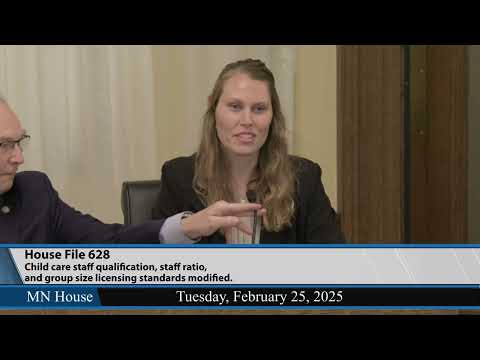
Maria Harms, owner and director of Snug as a Bug Child Care in Redwood Falls, testified in favor of changes that she said would reduce regulatory burdens on providers. "Child care is the backbone to a productive working economy," Harms said, and she described operating a center with capacity for 74 children while managing licensing requirements and staff shortages.
The bill’s principal change would alter staff-qualification rules so that directors must meet identified education and experience requirements and could train other staff, while some present teacher/assistant/teacher‑aide qualification categories would be removed so those roles could be filled after on‑the‑job training and required trainings. Committee members and staff clarified the bill also moves several existing rule provisions into statute and directs the Commissioner of Children, Youth and Families to amend rules on what child records must be kept.
Committee members raised a range of concerns during more than an hour of discussion. Representative Sensamura and others questioned whether lowering qualification requirements for classroom staff would reduce quality and whether any cost savings would be passed to parents. Representative Coulter and Representative Kolter warned against "a race to the bottom" on qualifications; Kolter emphasized early education research and said "80% of brain development happens by age 3 and 90% by age 5," arguing qualifications matter to children’s learning.
Representatives and witnesses also probed health‑and‑safety implications of proposed recordkeeping changes. Harms and other proponents said some detailed data collection (for example, extended medical or dental contact lists) can be burdensome and that in a true emergency staff would contact 911. "If a certain center wants to ask for that, great, but I don't think as a state we should be requiring extensive information," Harms said. Representative Perez Vega and Representative Hicks pushed back, expressing concern that removing or loosening requirements could leave centers without critical medical information for children with chronic conditions such as Type 1 diabetes.
Nonpartisan staff and licensing officials answered technical questions about current requirements. "I am not aware of any requirements under current law or rules requiring how many hours a director needs to be in the center," nonpartisan staff member Ms. Bock said in response to a question about director presence. Alyssa Dotson, Deputy Inspector General for the Licensing Division, told the committee she would follow up on whether and when unsupervised volunteers may be allowed and what existing rules require.
Committee members also asked about staff-to-child ratios and maximum group sizes cited in the bill text. Nonpartisan staff explained those numbers (for toddlers, a 1-to-7 staff ratio with a maximum group size of 14) currently appear in rule and are carried into the DE1. "That is what we currently follow," Ms. Hirons said, adding she could not identify the original stakeholders who developed the specific numeric limits decades ago.
Chair Torkelson framed the bill as one part of a broader response to high child‑care costs in Minnesota, noting state affordability challenges and budget constraints. He said the committee will need a bipartisan approach to pair regulatory adjustments with additional investments. "We also are aware we have a giant budget deficit," he said, and argued the state must balance safety with measures that make it economical for centers to operate; he noted Minnesota’s high infant‑care costs nationwide and cited an average figure he said is "over $20,000" for infant care at centers.
After discussion the committee adopted the DE1 amendment. The chair then renewed his motion to lay over House File 628 — as amended — for possible inclusion in a later omnibus bill.
The hearing included public testimony, extended member Q&A, and technical responses from nonpartisan staff and licensing officials; the file was not advanced for a committee vote beyond layover and will return in future negotiations and rulemaking discussions.