Get Full Government Meeting Transcripts, Videos, & Alerts Forever!
Get email alerts on the Corrections Prison Safety topic
No spam. Unsubscribe anytime.
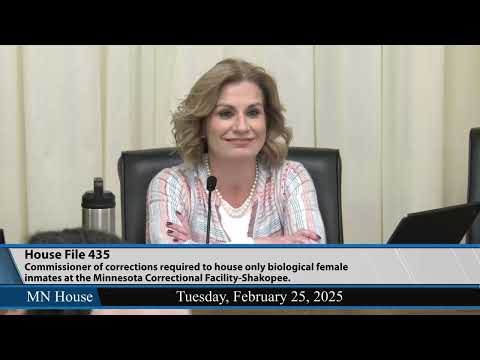
Committee adopts biological definition amendment to HF 435; bill to restrict Shakopee prison to ‘biological females’ laid over
Summary
During a hearing of the Public Safety and Finance Commission, members adopted an author27s amendment that defines “female” by biological characteristics and then heard testimony on House File 435, a bill that would require the commissioner of corrections to house only biological females at the Minnesota Correctional Facility in Shakopee.
During a hearing of the Public Safety and Finance Commission, members adopted an author27s amendment that defines “female” by biological characteristics and then heard testimony on House File 435, a bill that would require the commissioner of corrections to house only biological females at the Minnesota Correctional Facility in Shakopee.
The committee adopted the A2 amendment by voice vote; members then received testimony on the bill but did not take a final vote. Committee staff said a fiscal note had not been received and the bill was being laid over pending that analysis.
The amendment introduced statutory language intended to clarify “what a woman is.” As read into the record by the bill27s author, Representative Fransen, the amendment says in part that “female means a female is biologically determined by genetics and defined with respect to an individual27s reproductive system,” and that “a woman is an adult human female; a girl is a minor human female.” Representative Fransen described HF 435 as “a women27s rights bill” and said the measure is “about protecting women.”
Testimony at the hearing was sharply divided. Alicia Beckman, a former Department of Corrections GED teacher who worked at Shakopee, testified that changes after a lawsuit led to the transfer of a person into Shakopee in June 2023 and that the transfer left staff and incarcerated women feeling unsafe. Beckman said staff had limited training on the policy and described reports she said officers filed about harassment and intimidation of women. She told the committee she left her job in part so she could speak freely.
By contrast, witnesses opposing the bill argued it would endanger transgender people and would be unlawful. Devika Ghi, a private citizen, said research and statistics show transgender women face higher risk of violence in men27s facilities and are often safer in women27s facilities. Jessica (Jess) Braverman, legal director at Gender Justice, told the committee HF 435 would make prisons less safe and is likely unlawful; she cited recent litigation challenging a federal executive order and said courts have found similar policies likely to violate constitutional protections against cruel and unusual punishment. Reverend Dr. Justin Sabia Tanis, a seminary professor, and Lucy Amelia Geach also testified against the bill, saying it would harm incarcerated transgender people.
Commissioner Paul Schnell, representing the Minnesota Department of Corrections, described the agency27s current process for placement decisions. He said when someone in the system identifies as transgender the department27s review considers medical and behavioral-health input and nine factors including perpetration history, programming needs, gender expression, assigned security level and the individual27s safety concerns. Schnell said a trained, agency-level gender identity committee makes recommendations that the deputy commissioner and commissioner review. Schnell told the committee the system currently has 49 people who have identified as transgender and that the total prison population statewide is about 8,300. He said the department aims to manage safety but that placement decisions are complex and sometimes contested.
Committee members pressed the commissioner about whether placements could have been better communicated or phased; Schnell acknowledged the department could have provided more runway and prep in the particular case that followed the settlement. Representative Tabke and others asked for factual clarity about how the transfers occurred; Schnell said the department27s policy came in the wake of a lawsuit and a related settlement and that the objective had been to implement placement reviews as promptly as possible.
Several members noted the likely legal and fiscal consequences of enacting HF 435. Committee members asked who would defend the department if the law were challenged; department counsel said the attorney general27s office would defend the state. Representative Hollins and other members said the state could face costly litigation and that a federal judge27s preliminary rulings in related cases suggest a constitutional challenge is likely.
The committee recorded the A2 amendment as adopted by voice vote; it did not record a roll-call tally for the amendment or for the bill. After testimony concluded, committee staff said they had not yet received a fiscal note and the bill was being laid over for further consideration and analysis. The committee recessed and said it would reconvene later.