Get Full Government Meeting Transcripts, Videos, & Alerts Forever!
Get email alerts on the Transgender Prison Placement topic
No spam. Unsubscribe anytime.
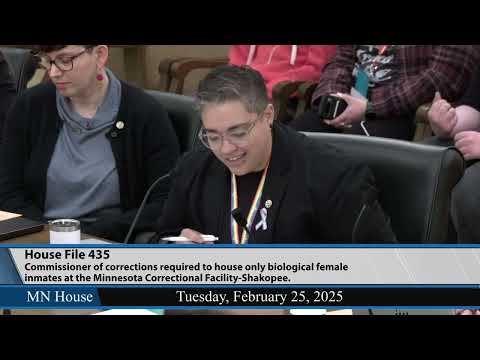
Minn. committee hears heated debate on House File 435, lays bill over after questions about inmate placement and safety
Summary
The Minnesota House Public Safety Committee discussed House File 435, a bill to restrict access to women-only correctional spaces, with testimony from corrections officials, a former Shakopee staffer and multiple legislators. Committee laid the bill over without a final vote.
The Minnesota House Public Safety Committee on an unspecified date heard more than two hours of testimony and debate on House File 435, a proposal that would define and restrict access to women-only spaces in the Minnesota Correctional Facility–Shakopee and other women’s correctional settings.
Supporters told the committee the measure is intended to protect safety in women-only facilities, while opponents said the bill targets transgender people and would increase risk for an already vulnerable group. The committee laid House File 435 over at the end of the hearing; no final passage or floor vote was recorded.
The bill’s author, identified in the hearing as Representative Franson, described House File 435 as aimed at “protecting biological women and keeping those spaces women only,” and said the change represented “common sense.” Several Republican committee members and witnesses framed the proposal as responding to safety concerns raised at MCF–Shakopee.
Opponents and several Democratic members said the bill singles out transgender people and risks harming them. Representative Pinto told the committee the measure would require the Department of Corrections to undertake “a full comprehensive either record review or much fuller diagnostic process than we do,” if the statutory definition were implemented. Representative Pinto warned that such procedures would be costly and could prompt litigation.
Commissioner Schnell of the Minnesota Department of Corrections told legislators that placement decisions currently rely on multiple factors and that the agency does not perform medical examinations solely to identify genital status for placement. “We do not conduct medical evaluations for the purposes of ascertaining a person's genitalia,” Commissioner Schnell said, adding that safety concerns are one of several considerations used in placement decisions and that placement for people identifying as transgender follows a policy-driven review.
Several legislators and a former corrections staffer who testified in favor of restricting access said that staff and incarcerated women at Shakopee have reported feeling unsafe. Alicia Beckman, who testified and described herself as a former staff member, said, “I do not believe the safety of the women of Shakopee has been taken into consideration at all,” and criticized what she described as a lack of training and notification when transgender individuals were transferred to Shakopee.
Committee members pressed agency officials for numbers. Committee testimony cited that the Department of Corrections oversees about 8,300 people; Commissioner Schnell said there are three transgender women currently placed at MCF–Shakopee. Commissioners and members also said transgender people are present across the corrections system but did not provide a single statewide count for all who identify as transgender; one legislator referenced a previously mentioned figure of about 49 but no confirming number was established on the record.
The hearing included sharp exchanges over whether the committee’s work should prioritize constitutional and human-rights protections for transgender Minnesotans. Representative Curran asked repeatedly whether transgender women “deserve safety and protection,” and Representative Pinto and others pressed the committee to affirm that the public safety remit covers everyone in the state. Several members said they were concerned that the bill is part of a broader series of proposals they view as targeting transgender people.
Committee members also discussed management alternatives when an incarcerated person in a male facility reports safety concerns. Commissioner Schnell said the department has “other management tools” and that transfer to Shakopee typically requires that a person identify as transgender; safety concerns alone, absent an identification claim, would not by themselves trigger transfer to the women’s facility.
The committee heard additional context from Commissioner Schnell about recent incidents involving staff misconduct: he said the department settled a 2024 lawsuit arising from an assault by a male staff member on an incarcerated woman for $500,000. Members cited that case as evidence that staff-on-inmate violence occurs and argued the risk of assault does not come from a single source.
After the testimony and debate the committee chair announced that House File 435 was laid over. The committee did not vote to advance or defeat the bill on the record during the hearing.
The hearing record shows sustained, partisan disagreement: proponents framed the measure as a safety-protection bill for biological women and staff at Shakopee; opponents said it targets transgender people, risks litigation and would not necessarily improve safety. The committee left the measure unresolved for now.