Get Full Government Meeting Transcripts, Videos, & Alerts Forever!
Get email alerts on the Corrections Policy topic
No spam. Unsubscribe anytime.
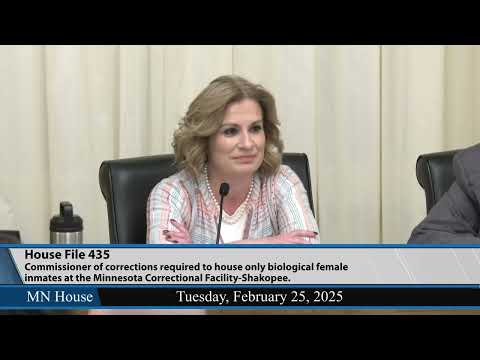
Minnesota committee hears testimony on bill to restrict Shakopee facility to "biological women"; House File 435 laid over
Summary
A Minnesota House public safety committee heard hours of testimony and debate over House File 435, a bill that would restrict Minnesota Correctional Facility–Shakopee to ‘‘biological women.’’ Lawmakers discussed DOC placement policy, safety concerns, and legal risk before laying the bill over for later consideration.
A Minnesota House Public Safety Committee hearing on House File 435 drew extended testimony and heated exchanges over whether the state women’s prison in Shakopee should be limited to people the bill’s author described as "biological women." After hours of discussion, the committee laid the bill over for future consideration.
House File 435, introduced in committee as a measure to keep certain correctional spaces restricted by biological sex, generated debate over safety, placement policy and how the Department of Corrections assesses gender identity for placement. Representative Branson, the bill’s author, told the committee, "Members, House file 4 35 is about protecting biological women. So that's enough. It is about keeping their spaces women only." The committee ultimately "laid over" the bill at the end of the session, meaning no final vote or recommendation was made.
The bill prompted repeated questions about how the Minnesota Department of Corrections (DOC) determines placement. Commissioner Paul Schnell, commissioner of corrections, explained the DOC’s placement practice and population size: "Minnesota Correctional Facility Shakopee is the state's women's facility ... and serves people who are committed ... to the Commissioner of Corrections," and later told the committee, "Mr. Chair, Representative Feist, we have 3 transgender women placed at Shakopee." Schnell also said the department manages placement decisions by reviewing records and multiple factors and that the agency does not conduct medical examinations solely to determine genital status for placement.
Testimony highlighted sharply different views on safety. Alicia Beckman, a testifier who said she worked at Shakopee, told the committee, "I do not believe the safety of the women of Shakopee has been taken into consideration at all," describing staff shortages and a feeling among some inmates and staff that transfers were not communicated or discussed. Several legislators pushed back with concerns about the broader effects on transgender people. Representative Pinto said, "Everyone deserves protection," and Representative Muller stressed that transgender women are more likely to be victims of crime than perpetrators.
Lawmakers also raised procedural and evidentiary questions about the bill’s record. Representative Berg and others asked the bill author about the sources used to justify the measure; Representative Branson and other supporters cited testimony from staff and inmates. Representative Pinto warned of fiscal and legal consequences if the bill becomes law, asking the chair whether the committee’s responsibilities include safety for all Minnesotans and urging attention to potential costs for litigation and operational changes.
Committee members and witnesses discussed the practical consequences of a statutory definition tied to biological characteristics. Representative Pinto asked whether a legal definition that required assessment of genetics or reproductive anatomy "would be virtually impossible without that full comprehensive either record review or fuller diagnostic process," a point Commissioner Schnell echoed, saying the DOC does not conduct those kinds of medical inspections routinely. Committee members also noted the DOC’s broader population of roughly 8,300 people under its care and raised questions about how many people systemwide identify as transgender; the commissioner said transgender people are identified across the system and may be in various stages of requesting services or review.
The hearing included references to a recent civil settlement involving the DOC. Commissioner Schnell told the committee that the state settled an October 2024 lawsuit related to an assault during transport for $500,000 after prosecution of the staff member involved. He cited that case when describing the spectrum of risks the department manages.
After extended questioning, debate and public testimony, Chair Franzen announced the bill "is laid over." The committee scheduled its next meeting for Wednesday, Feb. 26; no further procedural action on House File 435 was taken that day.
Votes at a glance: House File 435 — laid over (no committee vote recorded).