Get Full Government Meeting Transcripts, Videos, & Alerts Forever!
Get email alerts on the Education Student Attendance topic
No spam. Unsubscribe anytime.
Minn. education committee lays groundwork for multi-year effort on chronic absenteeism; adopts technical amendment
Summary
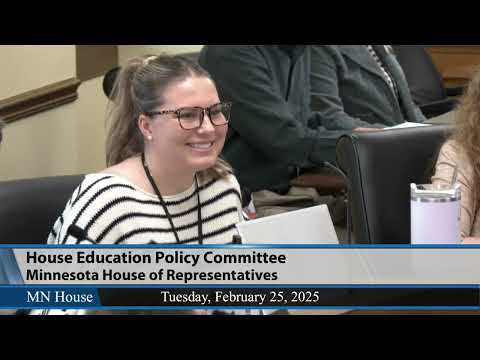
The Minnesota House Education Policy Committee on Feb. 25 debated a set of bills aimed at reducing chronic absenteeism and clarifying attendance rules, adopted an author27s amendment to House File 62 and laid over four other bills for further work.
The Minnesota House Education Policy Committee on Feb. 25 debated a set of bills aimed at reducing chronic absenteeism and clarifying attendance rules, adopted an author27s amendment to House File 62 and laid over four other bills for possible inclusion in an omnibus package.
Committee Chair Bennett recognized bill authors Representative Keeler and Representative Baikberg, who described the bills as the start of a multi-year, bipartisan effort to improve how schools, counties and state agencies track and respond to student absences. Representative Keeler27s package includes House File 62 as a "landing spot" to gather existing statutory language into one place; the committee adopted an A1 author27s amendment to HF62 during the hearing.
Why it matters: Committee witnesses and presenters said Minnesota27s attendance data lag and inconsistent definitions across districts make it difficult to target interventions. Matt Schaeffer, senior policy director at Ed Allies, told the committee "30 percent of students ... were chronically absent" in the 2021-22 school year and urged faster, more consistent reporting so districts and the state can identify and support students who miss the most school.
Schaeffer summarized the scale and limits of the data. He said the 30 percent figure represents roughly 236,101 students and that the Department of Education reported a later improvement to 25.5 percent (about 199,185 students). He warned the committee that the state currently lacks timely, disaggregated data by grade level and reasons for absence (excused, unexcused or suspension), and that the two-year lag in statewide reporting impedes response.
Committee authors outlined eight policy "buckets" from the legislative study group meant to guide the work: consistent definitions; state-local coordination; community engagement; Minnesota Department of Education (MDE) actions; data sharing between schools and counties; dedicated staff or liaison roles in schools; transportation; and community supports. Representative Keeler said the buckets are a playbook to get stakeholders and other committees involved rather than a final statutory blueprint.
Public testimony highlighted several issues the committee said it will consider. Jessica Webster, staff attorney with Legal Aid and the Minnesota Disability Law Center, urged caution that students with disabilities not be referred to child-protection systems or unenrolled when their disability explains absences: "we don't want children with disabilities to be referred to child protection or unenrolled where their disability explains why they've been absent." Erin Sandsmark of the Solutions Not Suspensions Coalition asked the authors to account for exclusionary discipline, saying: "Unnecessary and excessive suspension practices play into the absenteeism data." Ashley Hightower, who runs Hennepin County27s truancy program, said many students flagged as a "15-day drop" are lost to the system and recommended that the Department of Education and counties be more active in re-enrollment and follow-up. She told the committee: "When a student is 15 day dropped from enrollment, they then become a child in need of protection or services as a habitual truant."
Representatives and MDE staff discussed existing guidance and capacity. Assistant Commissioner Angela Mansfield and MDE legislative policy manager Megan Adeola told the committee the department issues guidance and is developing supports through its Compass statewide support system, but that reporting systems and student-information vendors vary by district. Adeola noted costs and scale differences compared with smaller states that report more timely attendance data; the department said it is assessing which data could be posted more promptly with minimal burden on districts.
Committee action and next steps: Representative Keeler moved the bills during the hearing. The committee adopted the A1 author's amendment to House File 62 by voice vote and then laid over the following bills for "possible inclusion in an omnibus bill or further consideration at a later date": House File 62 (as amended), House File 1030, House File 1053, House File 1054 and House File 1413. Authors said they will continue work with nonpartisan staff and stakeholders to refine statutory language, data definitions and any technical fixes before returning to committee.
The committee also heard several operational suggestions that do not require immediate legislation, including better application of existing MDE guidance, pilot district models, and local campaigns to raise attendance awareness. Members stressed that this is intended as a long-term, cross-agency effort requiring coordination with transportation, health and human services and workforce committees.
Votes at a glance - House File 62 (author27s A1 amendment adopted): A1 amendment moved by Representative Keeler; voice vote; amendment adopted. HF62 (as amended) laid over for possible omnibus inclusion. - House File 1030: moved and laid over for possible omnibus inclusion. - House File 1053: moved and laid over for possible omnibus inclusion. (Focused on clarifying the state role when students are dropped after 15 consecutive days.) - House File 1054: moved and laid over for possible omnibus inclusion (would require more timely reporting of current-year attendance data, aligned with achievement reporting). - House File 1413: moved and laid over for possible omnibus inclusion (includes a definition of consistent attendance and reporting deadlines).
What the hearing did not decide: The committee did not adopt final statutory language beyond the HF62 A1 technical amendment and explicitly left questions of funding, a new statewide data system, and enforcement/accountability for later sessions. Chair Bennett and the authors said the work will continue and that authors intend to return with refined bills. The next committee meeting was scheduled for Feb. 26.