Get Full Government Meeting Transcripts, Videos, & Alerts Forever!
Get email alerts on the Sentencing Mra Eligibility topic
No spam. Unsubscribe anytime.
Panel debates bill to expand list of violent crimes excluded from early‑release program
Summary
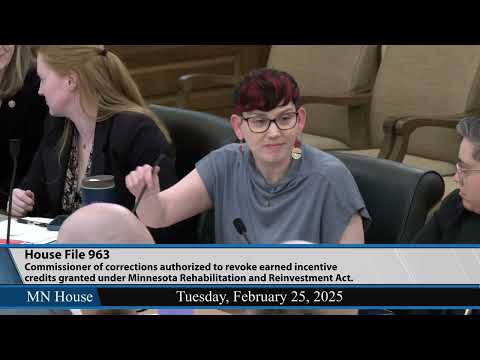
Representative Bliss presented House File 5 33, a bill that would expand the list of offenses that make an incarcerated person ineligible for earned incentive release credits under the Minnesota Rehabilitation and Reinvestment Act.
Representative Bliss presented House File 5 33, a bill that would expand the list of offenses that make an incarcerated person ineligible for earned incentive release credits under the Minnesota Rehabilitation and Reinvestment Act (MRA).
The sponsor told the committee the bill would carve out multiple violent and predatory offenses — including first‑degree murder; various degrees of criminal sexual conduct where force or weapon use is involved; assaults on peace officers, prosecutors, judges or corrections employees; dangerous offender designations; certain gang‑related crimes; and some first‑ and second‑degree controlled‑substance offenses — making those people ineligible for the MRA early‑release credits.
David Zimmer of the Center of the American Experiment testified in support, telling members that the shift in 2023 from earlier good‑time rules to a program with potential release at 50 percent of an executed sentence was too broad and that the bill restores exceptions for the most serious offenses. "I urge you to vote yes on House File 5 33," Zimmer said.
David Behnke of the Minnesota Incarcerated Workers Organizing Committee testified in opposition. He argued removing eligibility for broad classes of people would reduce incentives to participate in programming and said the committee should focus on expanding programming and retroactive application of the department’s MRA implementation rather than narrowing eligibility. "If you exclude so many people from something people will not participate or have an incentive," he said.
Committee members questioned how the bill would interact with existing department rules and the exercise of prosecutorial and judicial discretion in downward departures. Representative Pinto and others noted the department’s rulemaking already excludes some people — for example, people with sentences under 365 days and people assessed as high risk or placed on intensive supervised release — and suggested the sponsor consider folding some rule exclusions into statute for permanence. Commissioner Paul Schnell told the committee department policy delays applying credits until near eligibility and that many exclusions are addressed by rule and policy; he said the bill would codify some of those policy choices.
Members also debated retroactivity: the sponsor said her concern includes sentences that have already been reduced through plea bargaining or downward departures, which in her view could be further shortened by the MRA framework; others said the bill does not change those negotiated sentences but would remove an incentive for programming. The committee laid House File 5 33 over because a fiscal note had not been received.
Ending: The committee did not vote on the bill and will revisit it after fiscal staff provide a cost estimate; members asked DOC and staff to provide the rule‑based exclusions and to help clarify which categories, if any, should move from rules to statute.